
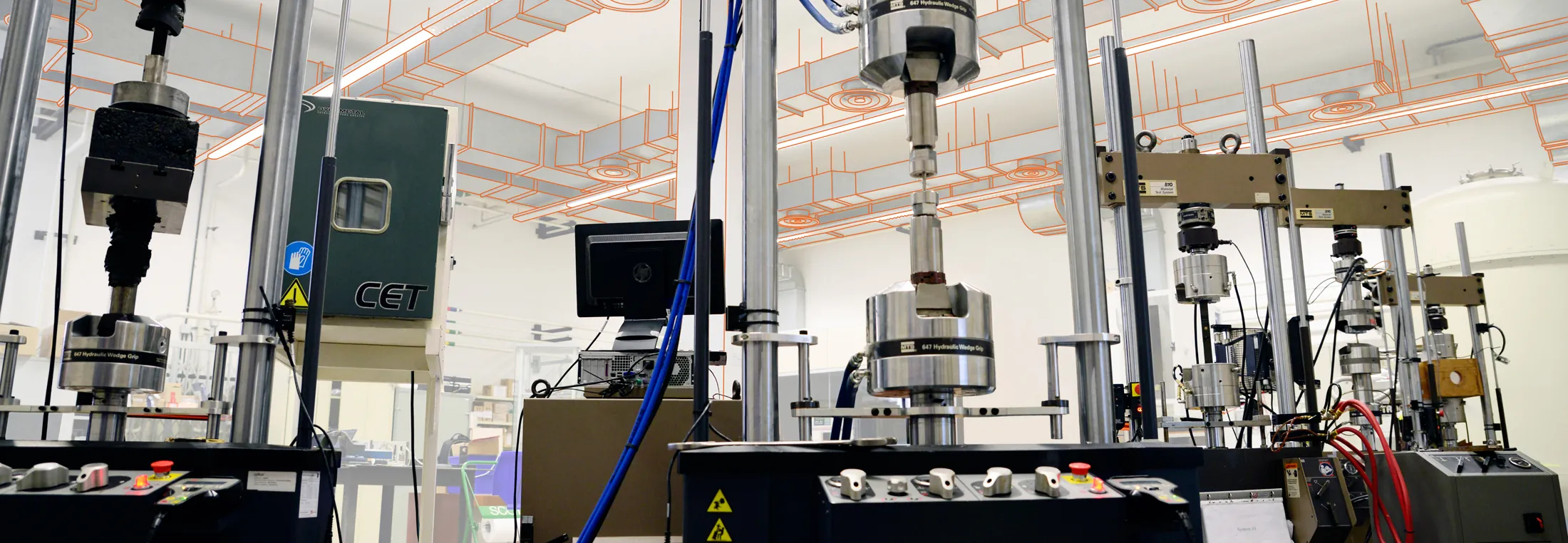
Tensile · compression · flexure
Universal testing machines sized to your specimens
Electromechanical and servo-hydraulic universal testing machines for metals, rebar, wire, plastics, rubber, composites and construction materials, configured with the right grips, extensometers and software for your standards.
On this page
Overview
What a universal testing machine does
A universal testing machine (UTM) applies a controlled tensile or compressive force to a specimen and records force and deformation until a target is reached or the specimen fails. From that data it calculates properties such as yield strength, tensile strength, elongation, modulus, compressive strength and flexural strength.
It is called universal because one frame, fitted with different grips and fixtures, can run tensile, compression, bend, peel, tear and shear tests on many materials. That flexibility makes the UTM the backbone of most mechanical testing laboratories, from steel mills and rebar producers to universities and plastics converters.
Choosing the right universal testing machine is mostly about matching three things to your work: the force capacity, the drive type (electromechanical or hydraulic) and the accessories your standards require. We help you specify all three.
What we supply
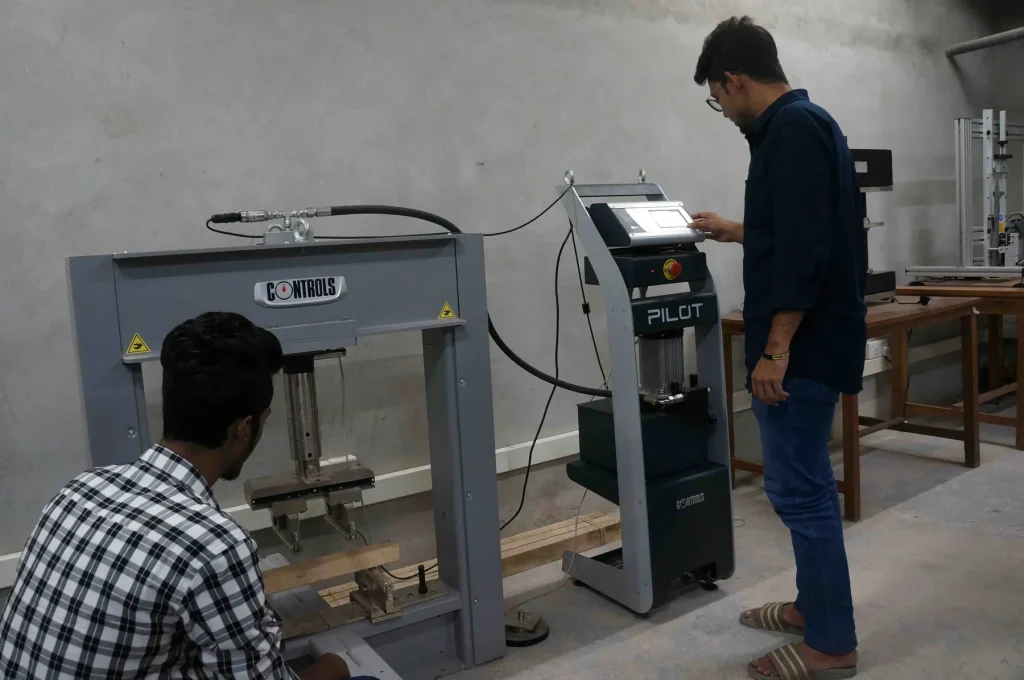
Universal testing machine configurations we supply
Frames, load cells and accessories are specified together so the system meets your test methods.
Electromechanical UTMs
Screw-driven frames with precise speed control and excellent low-force resolution, ideal for plastics, rubber, wire, sheet and textiles.
Servo-hydraulic UTMs
High-capacity frames for rebar, plate, structural steel and large specimens where hundreds of kilonewtons are needed.
Wedge & hydraulic grips
Grips matched to round bars, flat strips, rebar or wire, with jaw faces sized to your specimens.
Extensometers
Clip-on and non-contact extensometers for accurate strain, modulus and proof-stress measurement.
Compression platens
Platens and spherical seats for compression testing of metals, concrete, foams and components.
Bend & flexure fixtures
Three- and four-point bend fixtures for metals, plastics, composites and weld bend tests.
Environmental chambers
Temperature chambers for testing materials above or below room temperature.
Testing software
Method libraries, automatic result calculation, report templates and data export for QC and accreditation.
Calibration & verification
Force and extensometer verification support to keep results traceable and audit-ready.
Test methods
Typical universal testing machine standards
The standard defines speed control, extensometer class, specimen geometry and reporting.
| Material / test | Typical standards | Key results |
|---|---|---|
| Metals: tensile | ASTM E8/E8M · ISO 6892-1 | Yield, tensile strength, elongation |
| Reinforcing steel | ASTM A615/A615M · BS 4449 · ISO 15630-1 | Yield, tensile, Rm/Re ratio, bend |
| Plastics: tensile | ASTM D638 · ISO 527 | Tensile strength, modulus, elongation |
| Plastics: flexural | ASTM D790 · ISO 178 | Flexural strength and modulus |
| Rubber: tensile | ASTM D412 · ISO 37 | Tensile strength, elongation at break |
| Force verification | ISO 7500-1 · ASTM E4 | Machine force accuracy class |
Buying guide
How to choose a universal testing machine
The decisions that matter most, in the order we work through them with customers.
Force capacity
Calculate the highest force you will need: tensile strength × cross-sectional area of your largest, strongest specimen, plus a safety margin. A 20 mm rebar of grade 60 needs far more capacity than plastic dog-bones, so a lab testing both may need two machines or a carefully chosen load cell range.
Electromechanical or hydraulic
Electromechanical machines offer precise speed and position control and quiet operation, and suit most tests up to medium capacities. Servo-hydraulic machines deliver very high forces in a compact frame and suit rebar, plate and heavy structural specimens.
Grips and fixtures
Most testing problems, such as jaw breaks, slippage and scatter, come from the wrong grips. Match grip type and jaw faces to specimen shape and material, and budget for spare jaw faces as consumables.
Strain measurement
If you report modulus, proof stress or yield to a standard, you need an extensometer of the right class. Crosshead displacement alone is not accurate enough for these results.
Software and reporting
Look for ready-made methods for your standards, automatic result calculation, customisable reports, export to Excel or LIMS, and user permissions. Good software saves operator time on every test.
Installation and service
Check floor space, foundation and power requirements, and confirm local support for training, calibration and spare parts before you buy.
Technical guide
Universal testing machine explained: a technical guide
Load cells and force accuracy
The load cell converts force into an electrical signal. Its accuracy is usually specified across a range, for example from a small percentage of capacity up to full capacity. Testing very small forces on a very large load cell reduces accuracy, which is why labs with wide force ranges choose interchangeable load cells or separate machines. Force verification to ISO 7500-1 or ASTM E4 confirms the class of accuracy over the range you use.
Speed and strain-rate control
Modern standards such as ISO 6892-1 define test speed in terms of strain rate in the elastic and plastic regions. A universal testing machine with closed-loop control can follow these rates using feedback from the extensometer, giving results that are comparable between laboratories. Simpler constant-crosshead-speed control is adequate for many product tests but may not satisfy every method.
Standards
Universal testing machine standards explained
ASTM E8/E8M and ISO 6892-1
The core tensile methods for metals. They define specimen shapes, gauge lengths, speed control and how to determine yield strength, proof stress, tensile strength and elongation. ISO 6892-1 includes a strain-rate-controlled method that needs closed-loop control and an extensometer.
ASTM D638 and ISO 527
Tensile methods for plastics, with dumbbell specimens, test speeds suited to polymers, and modulus measurement that requires an accurate extensometer at low strains.
ASTM D412 and ISO 37
Tensile methods for rubber, using dumbbell or ring specimens and long-travel strain measurement because rubber stretches several hundred percent before breaking.
ISO 7500-1 and ASTM E4
Methods for verifying the force-measuring system of a testing machine, defining accuracy classes and how calibration is carried out.
Budgeting
Universal testing machine: what affects the price in Pakistan
Indicative factors that change a quotation. We always explain the options so you can balance budget and capability.
Capacity and frame stiffness
Price rises with force capacity and frame stiffness. A 10 kN tabletop frame costs far less than a 1,000 kN servo-hydraulic machine.
Drive and control
Closed-loop servo control with accurate strain-rate control (needed for ISO 6892-1 method A) costs more than basic constant-speed control.
Grips
Hydraulic and pneumatic grips are more expensive than manual wedge grips but improve consistency and throughput.
Extensometers
Clip-on extensometers are economical; automatic or non-contact extensometers cost more but remove operator influence.
Software
Standard-specific test methods, report templates and data export add value and cost.
Environmental options
Temperature chambers and special fixtures for high- or low-temperature testing add significantly to the system price.
Applications
Who uses universal testing machines
Rebar & steel producers
Tensile and bend tests for every heat to certify grade.
Fabricators & engineering
Weld procedure qualification and incoming material checks.
Plastics & packaging
Tensile, flexural and peel tests on resins, films and products.
Rubber products
Tensile and tear testing of compounds and finished goods.
Construction laboratories
Compression and flexure of concrete, mortar and building products.
Universities
Strength-of-materials teaching and materials research.
Set-up checklist
Universal testing machine buying checklist
Work through these points and your quotation will be faster and more accurate.
- List all materials and specimen geometries you will test
- Calculate the maximum force with a safety margin
- Choose electromechanical or servo-hydraulic drive
- Select grips and jaw faces for each specimen type
- Decide whether an extensometer is required by your standard
- Confirm software methods for your standards
- Check ceiling height, floor space and foundation requirements
- Confirm power supply and any hydraulic cooling needs
- Plan annual force and extensometer verification
- Book operator training at commissioning
After-sales
Support after installation
We coordinate installation and commissioning of your universal testing machine, set up test methods for your standards, and train operators on specimen preparation, gripping and result interpretation.
Afterwards we support force and extensometer verification, supply grips, jaw faces and fixtures, and help you add tests as your customers’ requirements grow.
Typical set-ups
Typical universal testing machine configurations
Three common starting points. Every quotation is tailored to your tests and budget.
Teaching & light-duty lab
A tabletop electromechanical frame of modest capacity with wedge grips, compression platens and basic software. Suits universities, plastics and rubber labs, wire and textile testing.
Production QC lab
A floor-standing electromechanical or servo-hydraulic frame sized to your product, with hydraulic or pneumatic grips, a clip-on extensometer and standard-specific test methods. Suits rebar, sheet, fastener and component producers.
Advanced & accredited lab
Adds automatic or non-contact extensometry, environmental chambers, multiple load cells, bend and special fixtures, and full traceable calibration. Suits third-party laboratories and research centres.
Avoid these
Common universal testing machine buying mistakes
Choosing capacity without calculating force
Always calculate maximum force from strength × area of your largest specimen, with headroom.
One machine for everything
Very high-capacity frames are poor at low forces. Labs testing both rebar and thin plastics often need two machines.
Underspecifying grips
Jaw breaks and slippage invalidate tests. Match grip type and jaw faces to each specimen.
No extensometer
Modulus, proof stress and yield to ASTM or ISO methods require direct strain measurement.
Ignoring speed control requirements
Some standards specify strain-rate control. Check the control system supports your method.
Forgetting space and safety
Allow room for loading long specimens, safety shields and operator access.
Maintenance
Maintenance and calibration schedule
A practical routine that keeps results accurate. Always follow the manufacturer instructions and your quality system.
| Interval | Recommended tasks |
|---|---|
| Daily | Inspect grips and jaw faces; check load reading at zero; review test parameters. |
| Weekly | Clean grips and fixtures; check extensometer knife edges; back up data. |
| Monthly | Lubricate screws or check hydraulic oil per manufacturer guidance; inspect cables and safety devices. |
| Annually | Verify force to ISO 7500-1 or ASTM E4 and extensometers to ISO 9513 or ASTM E83. |
| As needed | Replace worn jaw faces and damaged fixtures. |
Request for quotation
Universal testing machine quotation checklist
- Materials and specimen shapes
- Standards for each test
- Maximum force required
- Specimen dimensions and gauge lengths
- Whether an extensometer is required
- Test temperatures if not ambient
- Expected tests per day
- Reporting and data export needs
- Available space and power
- Delivery city and timeline
Local support
Universal testing machine support across Pakistan
We help laboratories across Pakistan size, configure and install universal testing machines, from university teaching labs to rebar producers in Punjab and Sindh.
We set up test methods for your standards, train operators, and support force and extensometer verification afterwards, with grips, jaw faces and fixtures supplied as your testing grows.
Glossary
Universal testing machine glossary
Load cell
The force transducer that measures applied load.
Crosshead
The moving beam that applies tension or compression to the specimen.
Extensometer
A device that measures specimen strain directly over a gauge length.
Proof stress (Rp0.2)
The stress producing 0.2% permanent strain, used when yield is not distinct.
Modulus of elasticity
The ratio of stress to strain in the elastic region.
Strain-rate control
Controlling test speed by the strain rate of the specimen rather than crosshead speed.
Accuracy class
The force-measurement accuracy grade defined by ISO 7500-1 or ASTM E4.
Daylight
The usable vertical space between crossheads for specimens and fixtures.
Related equipment
Further reading: ASTM E4 force verification
FAQ
Universal testing machine: frequently asked questions
What capacity universal testing machine do I need?
Work out the maximum force from your strongest and largest specimen (tensile strength × cross-sectional area) and add a safety margin. Plastics and wire labs often need 5–50 kN; rebar and structural steel labs typically need several hundred kilonewtons or more. We size the frame and load cell to your actual specimens.
Is an electromechanical or hydraulic UTM better?
Neither is better in general. Electromechanical machines give precise control and suit most tests up to medium forces; servo-hydraulic machines suit very high forces such as rebar and plate. Many steel labs use hydraulic frames, while plastics and rubber labs use electromechanical ones.
Do I need an extensometer?
If you must report modulus, proof stress (Rp0.2) or yield precisely to ASTM or ISO standards, yes. Crosshead movement includes machine and grip compliance, so it is not accurate enough for strain-based results.
Can one UTM test both metals and plastics?
Sometimes, if the force ranges overlap and you choose suitable load cells and grips. Very high-capacity frames lose resolution at low forces, so labs testing both heavy rebar and thin plastics are often better served by two machines.
How is a universal testing machine calibrated?
Force is verified with calibrated proving devices to ISO 7500-1 or ASTM E4, and extensometers to ISO 9513 or ASTM E83. Most labs verify at least annually. We can help arrange verification.
How much space does a universal testing machine need?
Tabletop electromechanical frames fit on a sturdy bench. Floor-standing and hydraulic frames need floor space, ceiling height for specimen loading, and sometimes a foundation. We review your site before quoting.
Can a UTM test bolts and fasteners?
Yes, with suitable fixtures for wedge tensile, proof load and other fastener tests.
Do universal testing machines need compressed air?
Only if you choose pneumatic grips or accessories. Manual and hydraulic grips do not require compressed air.
Is training included?
Yes. We include operator training at commissioning, covering specimen preparation, gripping, test setup and reporting.
Can I upgrade my UTM later?
Often yes. Grips, extensometers, fixtures and software modules can usually be added as your testing needs grow.
How long does a tensile test take?
Typically a few minutes per specimen, depending on material, specimen size and the speed requirements of the standard.
Can the machine produce test certificates?
Testing software produces reports with results and curves, which you can use for certificates under your quality system.
Do you supply bend test fixtures for rebar?
Yes, bend and rebend fixtures sized for the bar diameters you test.
Request a quote
Get a quote for a universal testing machine
An engineer replies within one working day with a recommendation and a quotation.
- Phone+92 21 3416 2044
- WhatsApp+92 331 229 5410
- Emailsales@comprehensive-sol.com
- OfficePlot No. 400, Delhi Saudagaran Society, Shah Faisal Colony, Karachi 75210