
Geotechnical · soil mechanics
Soil testing equipment for foundations built on data
Laboratory and field equipment for soil classification, compaction, strength and consolidation testing for geotechnical laboratories, site investigation firms, highway departments and universities.
On this page
Overview
What soil testing equipment tells engineers
Every foundation, road, embankment and dam design starts with soil data. Geotechnical engineers need to know what the soil is (classification), how it compacts (compaction and CBR), how strong it is (shear strength) and how much it will settle (consolidation).
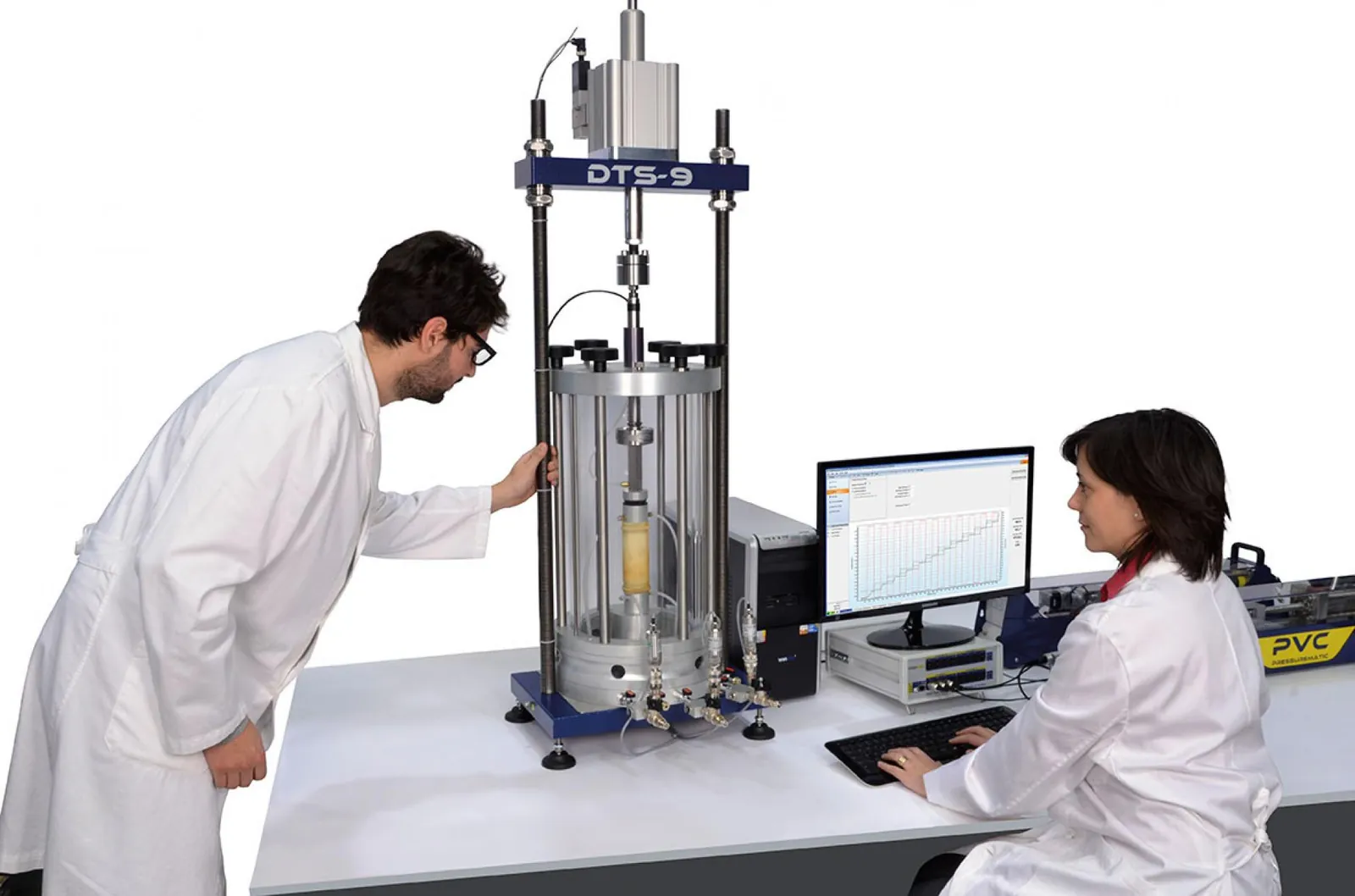
Each of those questions has its own laboratory test and its own soil testing equipment, from simple sieves and Atterberg limit apparatus to automated triaxial systems with pore-pressure measurement.
We supply complete soil testing laboratories and individual instruments, configured to the ASTM or BS methods your projects specify, with training for your technicians.
What we supply
Soil testing equipment we supply
From classification to advanced strength testing.
Triaxial testing systems
UU, CU and CD tests with pore-pressure measurement, manual to fully automated.
Oedometers
One-dimensional consolidation for settlement prediction.
Direct shear apparatus
Shear strength of soils along a defined plane.
Laboratory vane apparatus
Undrained shear strength of soft clays.
Unconfined compression testers
Quick strength of cohesive soils.
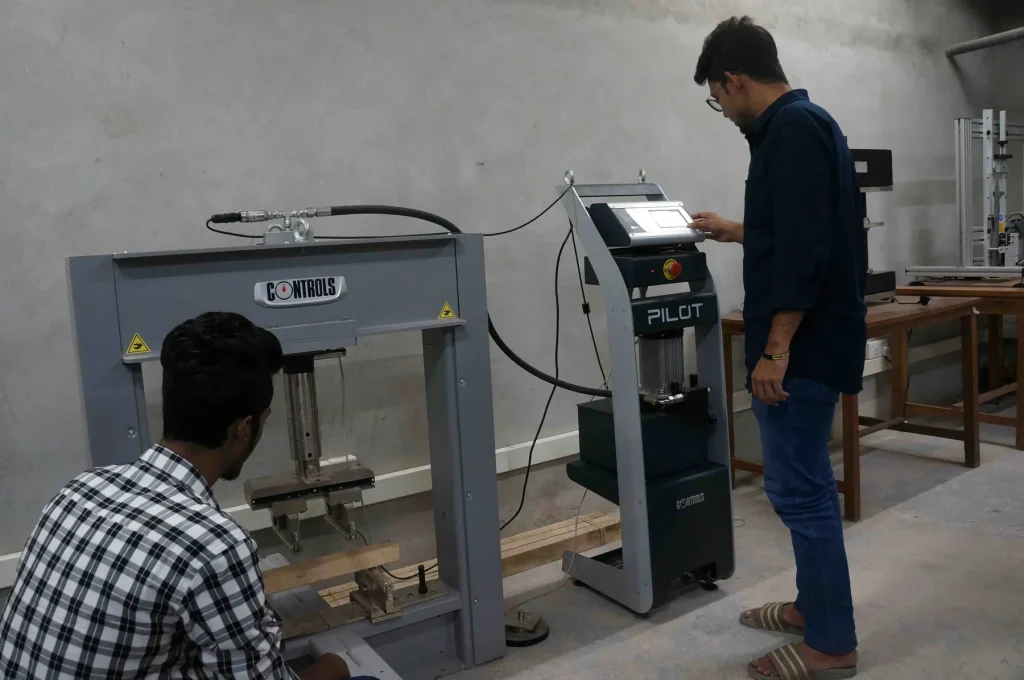
Proctor & CBR equipment
Compaction curves and California bearing ratio for pavement design.
Atterberg limits apparatus
Casagrande cups and cone penetrometers for liquid and plastic limits.
Sieves, shakers & hydrometers
Particle size distribution for classification.
Permeability apparatus
Constant- and falling-head permeability.
Field density equipment
Sand cone apparatus for compaction control on site.
Test methods
Soil testing standards
Common methods in Pakistani geotechnical practice.
| Test | Typical standards |
|---|---|
| Particle size (sieve) | ASTM D6913 · BS 1377-2 |
| Atterberg limits | ASTM D4318 · BS 1377-2 |
| Compaction (standard / modified Proctor) | ASTM D698 / D1557 |
| California bearing ratio | ASTM D1883 |
| Direct shear | ASTM D3080 |
| Triaxial UU / CU | ASTM D2850 / D4767 |
| One-dimensional consolidation | ASTM D2435 |
| Unconfined compression | ASTM D2166 |
| Laboratory vane shear | ASTM D4648 |
| Field density (sand cone) | ASTM D1556 |
Buying guide
How to equip a soil testing laboratory
Build capability in the order your projects need it.
Classification first
Sieves, hydrometers, Atterberg limits, moisture content and specific gravity underpin every geotechnical report and are the foundation of any soil lab.
Compaction and CBR for roads
Highway and earthworks projects depend on Proctor and CBR testing, often in high volumes. Automatic compactors improve consistency.
Shear strength
Direct shear is economical and fast; triaxial testing gives more complete strength parameters and is required for major projects.
Manual or automated triaxial?
Automated systems improve repeatability and reduce operator time, especially for CU tests with pore-pressure measurement. Manual systems suit teaching and lower volumes.
Consolidation capacity
Oedometer tests take days each, so the number of frames determines throughput.
Field equipment
Sand cone and field density equipment let you check compaction on site against laboratory results.
Technical guide
Soil testing equipment explained: a technical guide
Classification as the foundation
Every geotechnical report starts with classification: particle size, plasticity and moisture content. These tests are inexpensive but tell engineers how the soil is likely to behave and which further tests are needed. Reliable soil testing equipment for sieving and Atterberg limits is therefore the foundation of the laboratory.
Compaction and CBR for roads
Earthworks and pavement design depend on how soil compacts and how strong it is when compacted. The Proctor test finds the best moisture content for compaction, and CBR measures bearing strength for pavement design. These are among the highest-volume tests in many soil laboratories.
Choosing between shear tests
Direct shear tests are quick and economical, and suit many routine projects. Triaxial tests control drainage and confining pressure and measure pore pressure, giving strength parameters that better represent field conditions. Major structures, slopes and dams usually require triaxial testing.
Consolidation and settlement
Fine-grained soils compress slowly under load as water drains out. Oedometer tests measure how much and how fast settlement will occur, which is critical for foundations on clay. Because each test takes days, laboratories run several oedometers in parallel.
Sample quality
Undisturbed samples are needed for strength and consolidation testing. Careful sampling, transport and extrusion preserve the soil structure, while poor handling produces misleading results whatever soil testing equipment is used.
Field testing and quality control
Laboratory compaction results are used on site to check that fill has been compacted correctly. Field density tests such as the sand cone method compare in-place density with the laboratory maximum.
Data and reporting
Electronic data acquisition reduces transcription errors and speeds reporting, especially for triaxial and consolidation tests that generate large amounts of data.
Standards
Soil testing equipment standards explained
ASTM D6913 and BS 1377-2
Particle size distribution by sieving, the basis of soil classification.
ASTM D4318
Liquid limit, plastic limit and plasticity index, defining the consistency of fine-grained soils.
ASTM D698 and D1557
Standard and modified Proctor compaction tests determining maximum dry density and optimum moisture content.
ASTM D1883
California bearing ratio of laboratory-compacted soils for pavement design.
ASTM D3080
Direct shear test of soils under consolidated drained conditions.
ASTM D2850 and D4767
Unconsolidated-undrained and consolidated-undrained triaxial compression tests, the latter with pore-pressure measurement.
ASTM D2435
One-dimensional consolidation properties using an oedometer.
ASTM D1556
Field density by the sand cone method for compaction control.
Budgeting
Soil testing equipment: what affects the price in Pakistan
Indicative factors that change a quotation. We always explain the options so you can balance budget and capability.
Automation level
Automated triaxial and consolidation systems cost more than manual set-ups but save technician time and improve repeatability.
Number of stations
Throughput depends on the number of oedometers, shear boxes and triaxial cells.
Transducers and data logging
Electronic load, displacement and pore-pressure measurement adds cost and accuracy.
Compaction equipment
Automatic compactors cost more than manual rammers but improve consistency.
Field equipment
Sand cone and other field density equipment is a separate budget.
Consumables
Membranes, porous stones and filter papers are ongoing costs.
Applications
Who uses soil testing equipment
Geotechnical laboratories
Site investigation reports for buildings and infrastructure.
Highway departments
Subgrade, sub-base and embankment control.
Contractors
Earthworks compaction control on site.
Consultants
Design parameters for foundations and slopes.
Dams & irrigation
Embankment and foundation investigations.
Universities
Soil mechanics teaching and research.
Set-up checklist
Soil testing equipment buying checklist
Work through these points and your quotation will be faster and more accurate.
- List tests required by your projects and their standards
- Set up classification: sieves, hydrometer, Atterberg, moisture
- Add Proctor and CBR for road and earthworks projects
- Choose direct shear and/or triaxial for strength
- Plan oedometer numbers for consolidation throughput
- Decide on manual or automated data logging
- Provide drying ovens and accurate balances
- Equip field density testing
- Plan calibration of load rings and transducers
- Train technicians on sample preparation
After-sales
Training and support
We install soil testing equipment, train technicians on standard procedures, and help with calibration of load rings, transducers and gauges.
We supply membranes, porous stones, filter papers, moulds and other consumables.
Typical set-ups
Typical soil testing equipment configurations
Three common starting points. Every quotation is tailored to your tests and budget.
Classification & compaction lab
Sieves, hydrometer, Atterberg limits, ovens, balances, Proctor and CBR equipment for routine investigation and earthworks.
Full geotechnical lab
Adds direct shear, oedometers, unconfined compression and triaxial testing for foundation design.
Advanced research lab
Adds automated triaxial systems with pore-pressure measurement, cyclic testing capability and data acquisition.
Avoid these
Common soil testing equipment buying mistakes
Too few oedometers
Consolidation tests take days; one frame limits throughput.
Poor sample handling
Disturbed samples give misleading strength and compressibility.
No moisture control
Accurate moisture content underpins every test.
Manual data where precision is needed
Electronic transducers improve accuracy for triaxial and consolidation tests.
Uncalibrated load rings
Load measurement must be verified periodically.
Ignoring field testing
Field density checks connect lab results to site compaction.
Maintenance
Maintenance and calibration schedule
A practical routine that keeps results accurate. Always follow the manufacturer instructions and your quality system.
| Interval | Recommended tasks |
|---|---|
| Daily | Check oven temperatures and balances; clean equipment. |
| Weekly | Inspect membranes, O-rings and porous stones. |
| Monthly | Check transducer zero readings and cables. |
| Annually | Calibrate load rings, transducers and gauges. |
| As needed | Replace membranes, stones and filter papers. |
Request for quotation
Soil testing equipment quotation checklist
- Projects and standards
- Tests required
- Samples per week
- Manual or automated
- Triaxial type (UU/CU/CD)
- Number of oedometers
- Field testing needs
- Data logging
- Delivery city
- Training
Local support
Soil testing equipment support across Pakistan
We supply geotechnical laboratories, highway departments, consultants and universities across Pakistan.
We install equipment, train technicians and support calibration and consumables.
Glossary
Soil testing equipment glossary
Atterberg limits
Liquid and plastic limits describing soil consistency.
Proctor test
A compaction test giving maximum dry density and optimum moisture.
CBR
California bearing ratio, used in pavement design.
Triaxial UU / CU / CD
Unconsolidated-undrained, consolidated-undrained and consolidated-drained tests.
Pore pressure
Water pressure within soil pores during loading.
Consolidation
Volume change of saturated soil under load over time.
Oedometer
Apparatus for one-dimensional consolidation tests.
Vane shear
Undrained shear strength measured by a rotating vane.
Related equipment
Further reading: ASTM D4767 triaxial CU
FAQ
Soil testing equipment: frequently asked questions
Do you supply equipment for a new geotechnical laboratory?
Yes. We prepare an equipment list covering classification, compaction, shear strength and consolidation to match the standards your projects require.
Manual or automated triaxial system?
Automated systems improve repeatability and save operator time, especially for CU tests. Manual or semi-automated systems suit teaching labs and lower volumes.
What is the difference between direct shear and triaxial testing?
Direct shear forces failure along a fixed plane and is quick and economical. Triaxial testing controls drainage and confining pressure and measures pore pressure, giving more complete strength parameters.
Which tests are needed for road projects?
Typically classification, Atterberg limits, Proctor compaction, CBR and field density, plus moisture content.
Do you deliver soil testing equipment across Pakistan?
Yes, with installation and training at your laboratory or site.
How long does a consolidation test take?
Typically several days per specimen, which is why labs run multiple oedometers in parallel.
Do I need a triaxial system or is direct shear enough?
Direct shear suits many routine projects; triaxial testing is needed for detailed design and where drainage conditions matter.
Can you supply soil testing equipment for universities?
Yes, including teaching-oriented manual systems.
What equipment is needed for CBR?
A CBR mould set, compaction equipment, a soaking tank and a CBR load frame.
Do you supply field testing equipment?
Yes, including sand cone apparatus.
Do you supply automatic Proctor compactors?
Yes, as an option to manual rammers.
Can triaxial systems be upgraded later?
Often yes, from manual to automated control and data logging.
Do you supply sample extruders?
Yes, for extruding samples from tubes.
What is the difference between standard and modified Proctor?
Both determine maximum dry density and optimum moisture content, but modified Proctor uses a heavier rammer and greater drop height, representing heavier compaction equipment used for roads and airfields.
Can one triaxial system run UU, CU and CD tests?
Yes, if it has the necessary pressure control, pore-pressure measurement and volume change measurement for drained tests.
How long does a CBR test take?
Compaction and penetration take a short time, but soaked CBR requires several days of soaking before penetration testing.
Do you supply equipment for rock and soil in one lab?
Yes. Many geotechnical laboratories combine soil and rock testing equipment and share load frames where capacities allow.
What is a hydrometer test used for?
It determines the grain size distribution of fine particles (silt and clay) that are too small for sieving.
How do I start a small soil laboratory?
Begin with moisture content, sieve analysis, Atterberg limits, Proctor and CBR, which cover most road and building projects. Add shear and consolidation equipment as your projects require design parameters.
What accuracy do balances need in a soil lab?
It depends on the test; fine-grained tests such as Atterberg limits need higher resolution than bulk compaction samples. We recommend balances for each station.
Can soil testing equipment be used for aggregates?
Sieves, ovens and balances are shared, but aggregate tests such as abrasion and crushing value need their own apparatus.
Why do triaxial tests need saturation?
Consolidated undrained tests with pore-pressure measurement require saturated specimens so that pore pressures are measured correctly; back-pressure saturation achieves this.
Can you train our technicians on soil test procedures?
Yes. Training at installation covers sample preparation, test procedure, calculations and recording for each instrument, so your team produces consistent, defensible results from the first project.
What spare parts should a soil laboratory keep?
Keep spare membranes, O-rings, porous stones, filter papers, sieve brushes and load-ring or transducer cables. These small items stop tests most often when they run out.
How do I plan laboratory space?
Separate dusty preparation areas from precise testing and data stations, provide sinks and drainage near wet tests, and allow bench space for drying and weighing.
Request a quote
Get a quote for soil testing equipment
An engineer replies within one working day with a recommendation and a quotation.
- Phone+92 21 3416 2044
- WhatsApp+92 331 229 5410
- Emailsales@comprehensive-sol.com
- OfficePlot No. 400, Delhi Saudagaran Society, Shah Faisal Colony, Karachi 75210