
If you melt, buy or process metal, you need to know its chemistry. Two techniques dominate practical metal analysis: spark optical emission spectrometry (OES) and laser-induced breakdown spectroscopy (LIBS). Both identify elements from the light emitted by an excited sample — but they suit different jobs.
On this page
How spark OES works
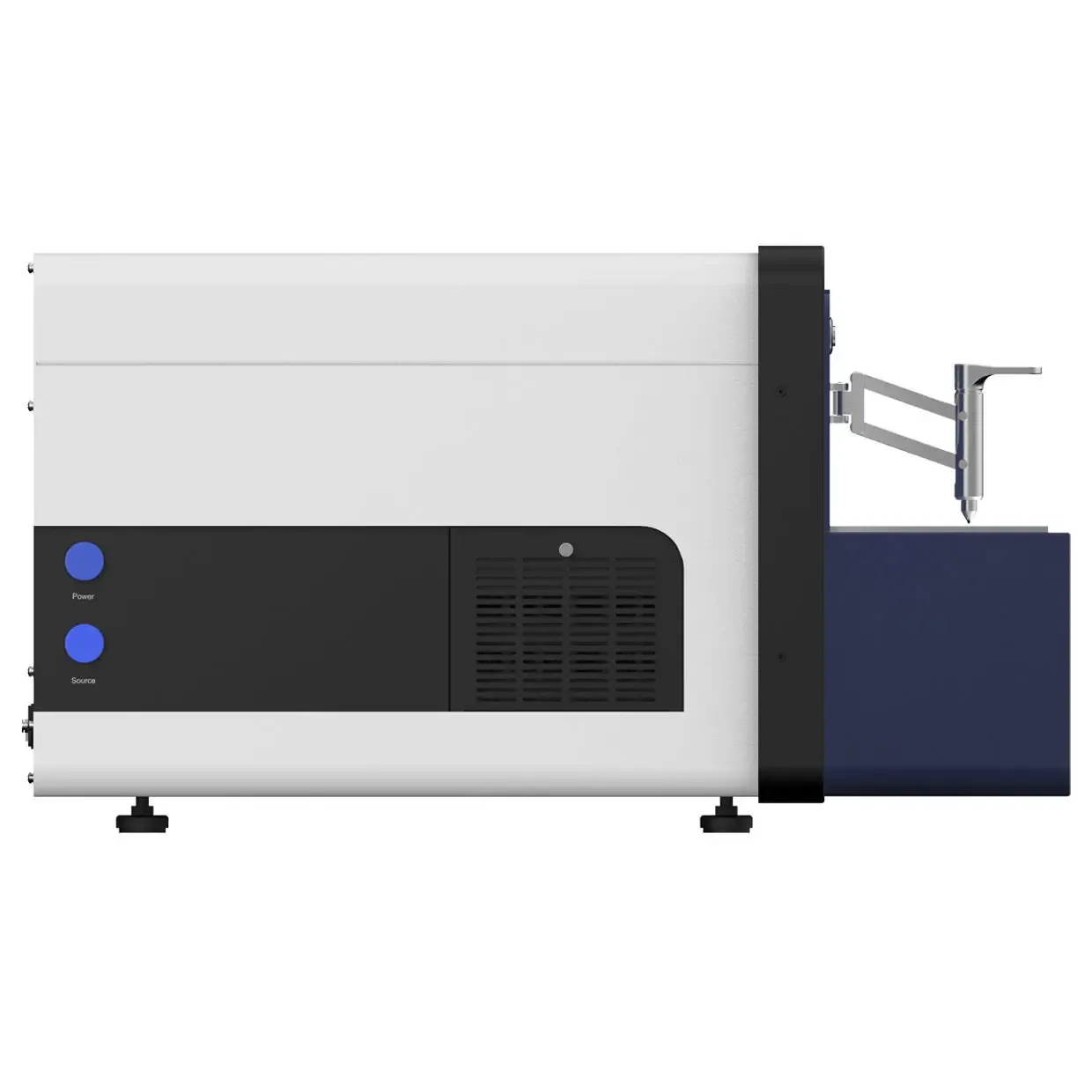
A spark OES instrument places the prepared sample on a spark stand. A controlled electrical discharge, usually in an argon atmosphere, vaporises and excites a tiny amount of the surface. The excited atoms emit light at wavelengths characteristic of each element; an optical system separates the wavelengths and detectors measure their intensity. Calibration curves convert intensities into concentrations.
Because the excitation is controlled and the light path can be optimised for short wavelengths, spark OES is the established laboratory method for complete analysis of steels, cast irons and non-ferrous alloys — including carbon, phosphorus, sulphur and, on suitable instruments, nitrogen.
How LIBS works
LIBS replaces the spark with a focused laser pulse, which creates a small plasma on the sample surface. The plasma light is analysed in the same way. Because no spark stand or large argon supply is needed, LIBS analysers can be made compact and handheld.
Key differences
- Where you use it: spark OES is a laboratory or plant-floor instrument; handheld LIBS goes to the material — warehouse racks, scrap yards and installed components.
- Sample preparation: spark OES needs a flat, freshly ground or milled surface; handheld LIBS needs a clean spot, often prepared with a small grinder.
- Scope of analysis: spark OES offers full quantitative analysis across many elements and matrices. Handheld LIBS is typically used for fast grade identification and specific tasks.
- Carbon: carbon is critical for steel grades. Many handheld techniques cannot measure it; some LIBS analysers are designed specifically to do so — for example Arun Technology’s CALIBUS, a CMOS-based LIBS device for carbon in ferrous materials.
Which should you choose?
Choose spark OES if you need certified-grade analysis in a lab, melt control in a foundry, or analysis of many alloys across several base metals. Choose handheld LIBS if you need fast checks on stock, incoming material or installed parts away from the lab. Many plants use both: OES as the reference in the laboratory and LIBS for positive material identification elsewhere.
Questions to answer before buying
- Which base metals do you analyse — iron, aluminium, copper, nickel?
- Which elements and what ranges matter, especially carbon and trace elements?
- How many samples per shift, and where will they be tested?
- Which standards do customers expect — for example ASTM E415 for carbon and low-alloy steel?
We supply Arun Technology’s ARTUS 8 and MERLIN 4 spark OES and the CALIBUS LIBS analyser in Pakistan. See our optical emission spectrometers or ask us to recommend a configuration.