
COLLIN Lab & Pilot Solutions · Germany
Pilot plant systems that de-risk every new formulation
Laboratory and pilot-scale polymer processing systems from COLLIN for material development, formulation trials, quality control and small-batch production.
On this page
Overview
Why use a pilot plant before production
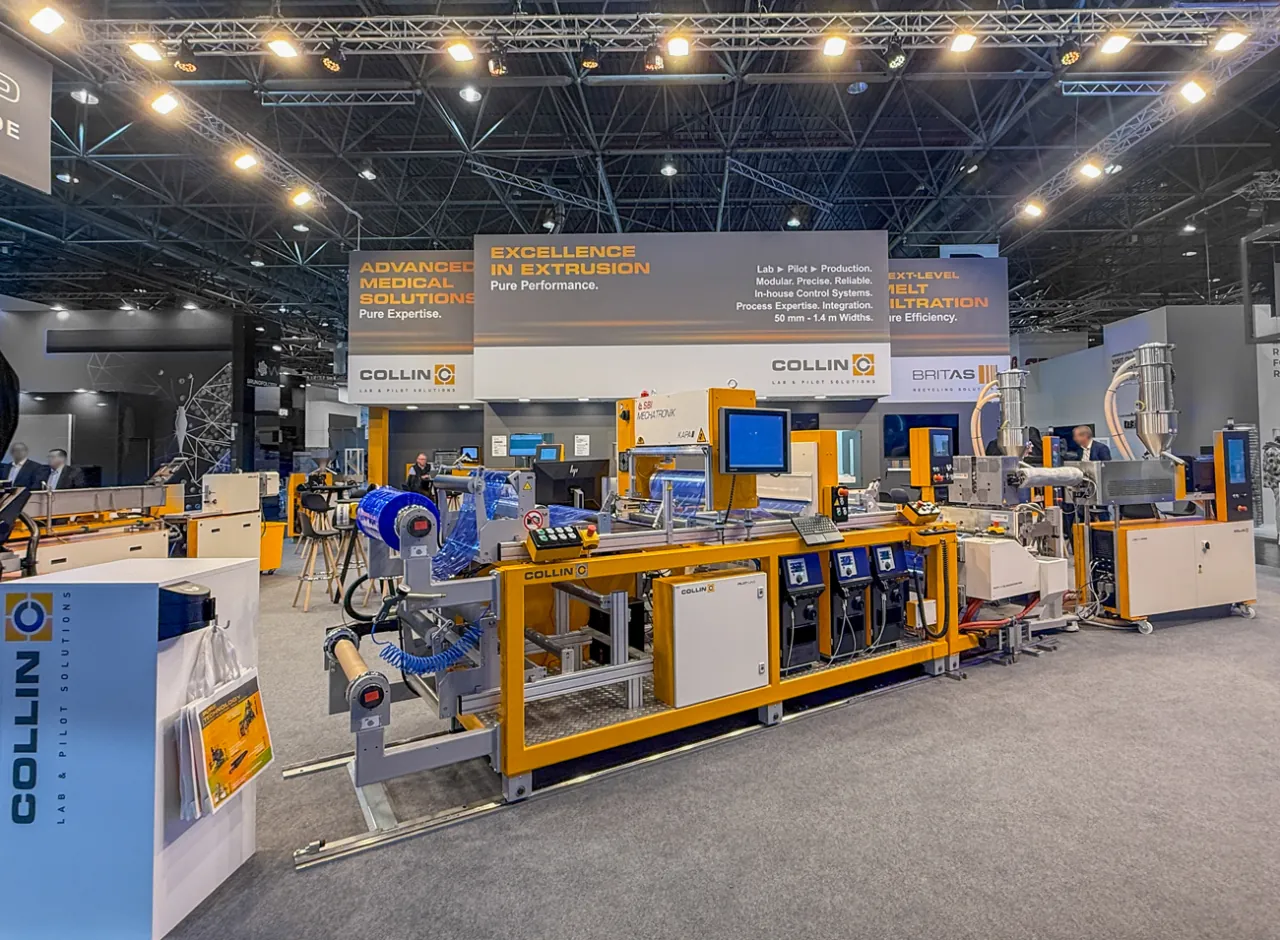
A pilot plant reproduces industrial polymer processing (extrusion, compounding, blown and cast film, milling and pressing) at a scale that needs only small quantities of material. That makes it practical to test new formulations, additives and masterbatches, train staff, and produce samples for customers without stopping a production line.
COLLIN Lab & Pilot Solutions of Germany specialises in exactly this equipment. Its systems are modular, so a line can be configured for your process today and expanded as your development programme grows.
As COLLIN’s authorised distributor in Pakistan, we help you configure the right pilot plant or lab line, coordinate installation and training, and support it afterwards.
What we supply
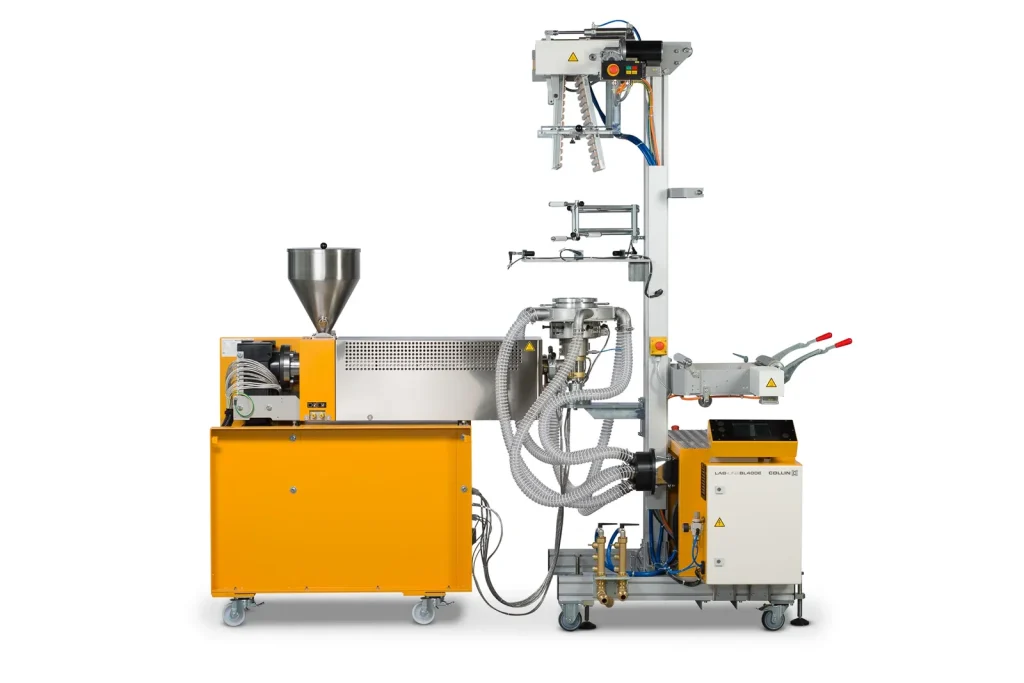
COLLIN pilot plant and lab systems we supply
Modular systems configured for your process.
Laboratory extruders
Single- and twin-screw extruders for processing trials, compounding and specimen production.
Compounding systems
Twin-screw compounding for masterbatch, filled and modified polymer development.
Blown film lines
Lab and pilot blown film lines, including multi-layer configurations, for packaging development.
Cast & flat film lines
Cast film and sheet lines for film and sheet development and testing.
Two-roll mills
Mixing and homogenising of polymer and rubber compounds and preparation of rolled sheets.
Platen presses
Compression moulding of test plates and specimens under controlled temperature and pressure.
Tubing & filament lines
Lines for medical multi-layer tubing and 3D-printing filament development.
Downstream equipment
Take-offs, winders, cooling and measurement units to complete a line.
Teaching configurations
Compact systems suited to university polymer processing laboratories.
Buying guide
How to specify a pilot plant line
Define the process first, then the machines.
Define the products
Film, sheet, compound, tube or filament each need a different die and downstream. Start from the samples you need to produce.
Throughput and material quantity
Lab lines run on small batches; pilot lines approach production conditions. Choose based on the trial size and how close to production you need to be.
Screw and die design
Screw geometry and die design should reflect your production process so trial results transfer to the full-scale line.
Measurement and control
Melt pressure, temperature and gauge measurement make trials repeatable and data-driven.
Modularity
Modular systems let you add co-extrusion layers, dies or downstream units later as your programme expands.
Site and utilities
Confirm power, cooling water, compressed air and space before installation; we review this with you.
Technical guide
Pilot plant explained: a technical guide
Why lab-scale trials save money
Trialling a new formulation on a production line consumes large amounts of material and line time, and risks off-spec product. A pilot plant uses small quantities, runs under controlled conditions, and lets engineers change one variable at a time.
Scale-up considerations
Results from a pilot plant transfer best to production when screw design, die geometry and processing conditions are representative. Discussing your production equipment when configuring the line makes scale-up more reliable.
Blown film development
Blown film lines let developers test resin blends, layer structures and additives, measuring properties such as gauge uniformity, optics and mechanical strength on real film.
Compounding and masterbatch
Twin-screw compounding at lab scale is used to develop masterbatch, filled and modified compounds, and to produce small batches for customer trials.
Mills and presses for specimens
Two-roll mills and platen presses prepare consistent sheets and plates for testing, linking processing trials directly to plastic and rubber testing.
Teaching and research
Universities use pilot plant equipment to teach polymer processing and to research new materials, giving students hands-on experience with industrial processes.
Data-driven development
Recording melt temperature, pressure, screw speed and output for each trial builds a knowledge base that speeds future development.
Standards
Pilot plant standards explained
Film properties
Films produced on a pilot plant are commonly tested for gauge uniformity, tensile properties, dart impact and optical properties using standard methods such as ASTM D882 for tensile properties of thin sheeting and ASTM D1709 for dart impact.
Melt flow and rheology
Melt flow rate (ISO 1133 or ASTM D1238) and rheological measurements help relate material properties to processing behaviour on the line.
Dispersion and filter tests
Colour and additive dispersion can be assessed on film or plates; some specifications use filter pressure value tests such as EN 13900-5.
Compound properties
Compounds produced at lab scale are tested for mechanical, thermal and density properties using the same ISO and ASTM methods as production material.
Specimen preparation
Pressed plates from a platen press provide specimens for standard tests, linking processing trials to laboratory results.
Process documentation
Recording temperatures, pressures, screw speed and output for each trial makes pilot plant results reproducible and transferable to production.
Budgeting
Pilot plant: what affects the price in Pakistan
Indicative factors that change a quotation. We always explain the options so you can balance budget and capability.
Line type
Single extruders cost less than complete multi-layer film or compounding lines.
Screw diameter and throughput
Larger screws and higher throughput approach production scale and increase cost.
Number of layers
Each additional co-extrusion layer adds an extruder and die complexity.
Downstream equipment
Take-offs, winders and measurement units complete the line and add cost.
Control and measurement
Advanced control, gauge measurement and data logging add value for development work.
Installation
Utilities, cooling and installation support are part of the total investment.
Applications
Who uses pilot plant systems
Masterbatch & compounders
Colour and additive development, dispersion checks and customer samples.
Film & packaging
New structures and resins trialled without stopping production lines.
Resin producers & distributors
Application testing and technical service for customers.
Medical & specialty products
Tubing and specialty extrusion development.
Rubber compounders
Two-roll mill mixing and press moulding of test sheets.
Universities & research
Polymer processing teaching and research.
Set-up checklist
Pilot plant buying checklist
Work through these points and your quotation will be faster and more accurate.
- Define the products and samples you need
- Decide lab scale or pilot scale
- Select extruder type and screw geometry
- Choose dies and the number of layers
- Specify downstream take-off and winding
- Plan cooling water and compressed air
- Confirm power and floor space
- Define measurement and data needs
- Plan training on safe operation
- Agree spare parts and service support
After-sales
Installation and training
We coordinate installation and commissioning of COLLIN systems with the manufacturer and train your operators on safe, repeatable operation.
We support spare parts, screws, dies and service coordination so your pilot plant stays productive.
Typical set-ups
Typical pilot plant configurations
Three common starting points. Every quotation is tailored to your tests and budget.
Lab-scale compounding
A twin-screw lab extruder with feeder and pelletiser for formulation and masterbatch trials.
Film development line
A lab blown or cast film line with take-off and winder for packaging development and QC.
Pilot plant
Multi-layer co-extrusion with production-like downstream, measurement and controls for scale-up trials.
Avoid these
Common pilot plant buying mistakes
Buying too small
If trials must reflect production, choose screw design and scale carefully.
Ignoring downstream
Take-off, cooling and winding determine film quality as much as the extruder.
Too few layers
Adding layers later can be complex; plan for future structures.
Underestimating utilities
Cooling water, power and air must be ready.
No measurement
Without melt pressure, temperature and gauge data, trials are hard to repeat.
No training
Safe, repeatable operation needs trained operators.
Maintenance
Maintenance and calibration schedule
A practical routine that keeps results accurate. Always follow the manufacturer instructions and your quality system.
| Interval | Recommended tasks |
|---|---|
| Daily | Purge and clean after trials; check temperatures. |
| Weekly | Inspect screws, barrels and dies for wear. |
| Monthly | Check heaters, thermocouples and cooling. |
| Annually | Service gearboxes and drives as recommended. |
| As needed | Replace screw elements and die parts. |
Request for quotation
Pilot plant quotation checklist
- Products and samples
- Polymers processed
- Batch sizes
- Lab or pilot scale
- Layers and structures
- Downstream needs
- Measurement and control
- Utilities
- Space
- Delivery city
Local support
Pilot plant support across Pakistan
As COLLIN’s authorised distributor in Pakistan, we configure lines with you and the manufacturer, coordinate installation and train operators.
We supply spare parts and coordinate service so your pilot plant stays productive.
Glossary
Pilot plant glossary
Twin-screw extruder
An extruder with two intermeshing screws, ideal for compounding.
Co-extrusion
Combining several polymer layers in one die.
Blow-up ratio
The ratio of bubble diameter to die diameter in blown film.
Cast film
Film produced by extruding onto a chilled roll.
Two-roll mill
A mixer with two heated rolls for compounds.
Platen press
A press for moulding plates and specimens.
Masterbatch
Concentrated pigment or additive carrier.
Scale-up
Transferring a process from lab to production.
Related equipment
Further reading: COLLIN Lab & Pilot Solutions
FAQ
Pilot plant: frequently asked questions
How much material does a lab extrusion trial need?
Far less than a production trial, because lab-scale lines are designed for small batches. The exact quantity depends on the line and trial plan; we help estimate it.
Can a pilot plant line be configured for our process?
Yes. COLLIN systems are modular. We work with you and the manufacturer to configure extruders, dies and downstream equipment.
Is a pilot plant useful for quality control?
Yes. Producing film or plates from incoming resin or masterbatch reveals gels, dispersion and colour problems that simple lab tests miss.
Can universities use COLLIN equipment for teaching?
Yes. Compact configurations are suited to teaching and research laboratories.
Who installs and supports COLLIN equipment in Pakistan?
We do, as authorised distributor, in coordination with COLLIN.
Can a pilot plant line be moved or reconfigured later?
Modular COLLIN systems can often be reconfigured or extended with additional modules.
How much space does a lab film line need?
It depends on configuration; blown film towers also need ceiling height. We review your site.
Do you supply spare screws and dies?
Yes, through COLLIN.
Is training provided for pilot plant operation?
Yes, at commissioning.
Can a university buy a smaller teaching configuration?
Yes, compact systems suit teaching labs.
Can COLLIN lines process recycled material?
Yes, many configurations handle recycled and filled polymers; discuss your materials with us.
Is a pelletiser included?
Pelletising can be added to compounding lines.
Can you deliver to Faisalabad or Lahore?
Yes, across Pakistan.
What polymers can a COLLIN pilot plant process?
Typical polymers include polyolefins, PET, PA, PVC, TPE and many specialty compounds, depending on screw design and temperature capability.
Can a pilot plant make samples for customer approval?
Yes. Producing film or compound samples for customers is one of the most common uses of lab and pilot lines.
How much training do operators need?
Basic operation can be learned during commissioning, while optimising trials benefits from ongoing experience and manufacturer guidance.
Can one line make both film and compound?
Some modular set-ups allow switching dies and downstream units, but dedicated configurations are more efficient for frequent use.
What is the typical lead time for a COLLIN line?
Lead time depends on configuration and is confirmed in the quotation.
Can a pilot plant help reduce production scrap?
Yes. Testing new materials and settings on a pilot line before production reduces trial-and-error on full-scale equipment.
Is a pilot plant suitable for small companies?
Yes. Compact lab lines suit small compounders and converters that want to develop products in-house without disrupting production.
Can a pilot plant produce sellable product?
Pilot plants are designed mainly for development and samples, but some small-batch production of specialty products is possible depending on configuration.
What utilities does a pilot plant line need?
Electrical power, cooling water and often compressed air, plus adequate floor space and ceiling height for film towers. We review these before quoting.
How do I justify investing in a pilot plant?
Compare the cost of production trials, scrap and line downtime with the cost of a pilot line. Companies that run frequent trials often recover the investment quickly.
Can universities use a pilot plant for research grants?
Yes. Pilot-scale polymer processing equipment supports research projects, industry collaborations and student training.
Do you help with trial planning?
We can share general guidance and coordinate with COLLIN application specialists for specific trial questions.
Can a COLLIN line be integrated with existing extruders?
In some cases auxiliary units or downstream equipment can be combined with existing machines. Discuss your current equipment and we will review the options with COLLIN.
What documentation is supplied with a pilot line?
Operating manuals, safety documentation and, where applicable, electrical and mechanical drawings are supplied with COLLIN systems.
How is a trial recorded for repeatability?
Record material lots, temperature profile, screw speed, melt pressure, output and downstream settings for every trial, along with sample identification for later testing.
Can we visit a working COLLIN installation before buying?
Contact us to discuss demonstrations or application trials. Where possible we arrange trials with COLLIN so you can see results with your own materials before committing.
What warranty applies to COLLIN equipment?
Warranty terms are set by the manufacturer and stated in our quotation, together with the support and spare parts arrangements we provide in Pakistan.
Request a quote
Get a quote for a pilot plant or lab line
An engineer replies within one working day with a recommendation and a quotation.
- Phone+92 21 3416 2044
- WhatsApp+92 331 229 5410
- Emailsales@comprehensive-sol.com
- OfficePlot No. 400, Delhi Saudagaran Society, Shah Faisal Colony, Karachi 75210