
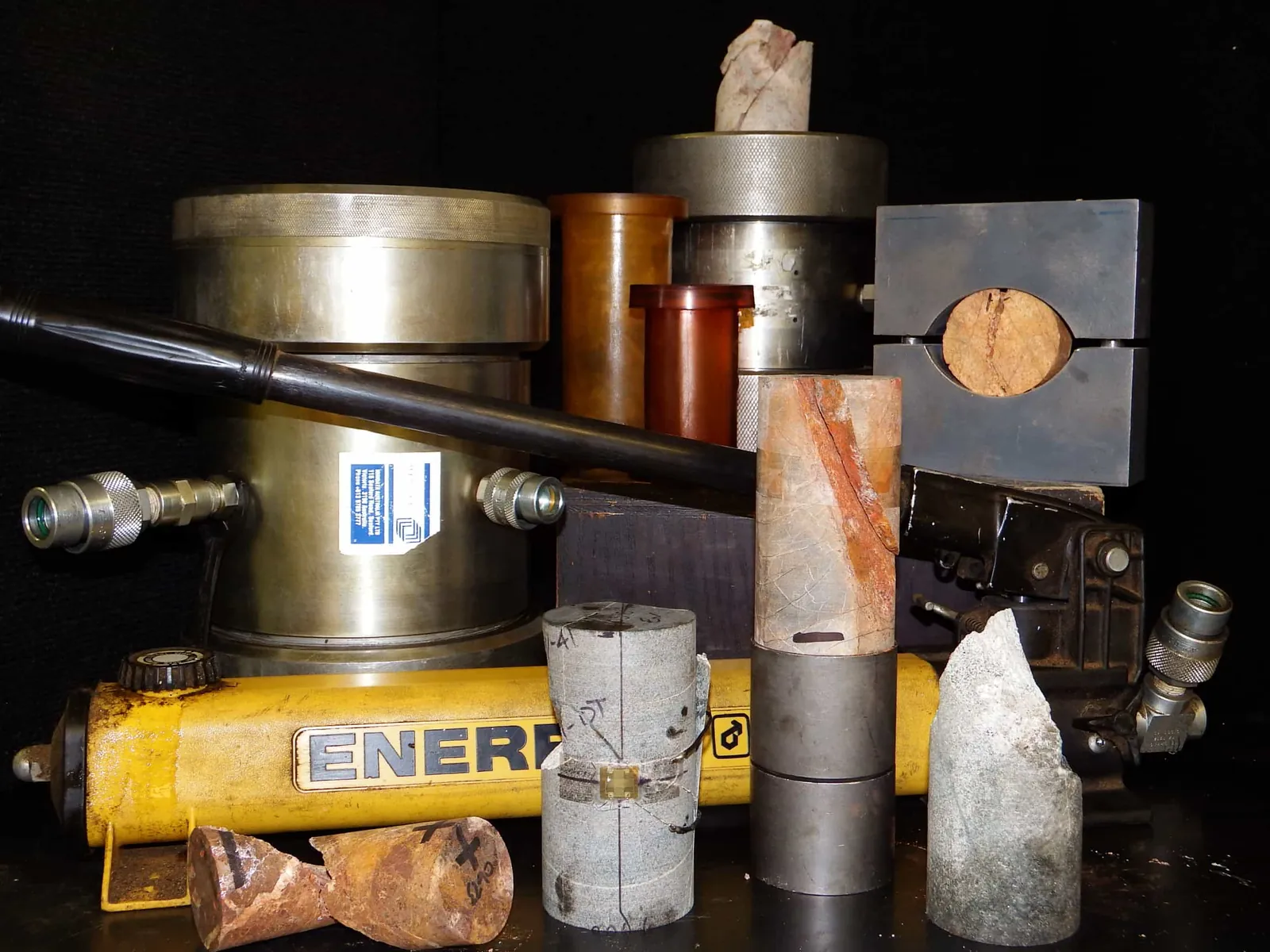
Rock mechanics · mining · tunnelling
Rock testing equipment for ground you can engineer
Specimen preparation and strength testing equipment for rock mechanics laboratories, mining and quarrying, dam and tunnel projects, and geology departments.
On this page
Overview
Why rock testing equipment starts with preparation
Rock strength drives the design of tunnels, dam foundations, slopes and mine openings, and the quality of aggregate from quarries. Laboratory rock testing measures uniaxial compressive strength, tensile strength, index properties and durability on cores drilled from the site.
Rock results are unusually sensitive to specimen preparation. Ends that are not flat and parallel, or cores of the wrong length-to-diameter ratio, produce low and scattered strengths. That is why a rock lab invests first in cutting and grinding equipment.
We supply rock testing equipment for each step, from saws and core grinders to point load testers and compression machines, configured to the ASTM and ISRM-style methods your projects use.
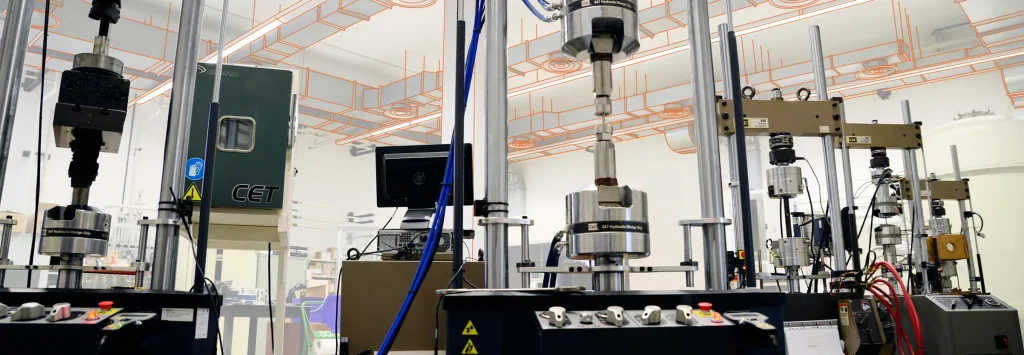
What we supply
Rock testing equipment we supply
Preparation, index and strength testing.
Rock core grinders
Flat, parallel specimen ends within the tolerances test methods require.
Masonry & core cutting saws
Accurate cutting of cores to length and of rock blocks.
Core drilling machines
Laboratory coring of block samples.
Point load index apparatus
Fast strength index on cores and irregular lumps, in the lab or field.
Compression testing machines
Uniaxial compressive strength with suitable capacity and platens.
Brazilian tensile fixtures
Indirect tensile strength of rock discs.
Slake durability apparatus
Durability of weak and clay-bearing rocks.
Rock Schmidt hammers
Rebound hardness for quick field estimates.
Test methods
Rock testing standards
Common ASTM methods for rock mechanics laboratories.
| Test | Typical standards |
|---|---|
| Core specimen preparation | ASTM D4543 |
| Point load strength index | ASTM D5731 |
| Uniaxial compressive strength | ASTM D7012 |
| Splitting tensile strength (Brazilian) | ASTM D3967 |
| Slake durability | ASTM D4644 |
| Rebound hardness (Schmidt hammer) | ASTM D5873 |
Buying guide
Setting up a rock testing laboratory
Priorities for reliable rock mechanics data.
Preparation equipment first
A core grinder and saw are the foundation of reliable results. Without them, even an excellent compression machine produces scattered data.
Point load for volume
Point load testing is fast and works on irregular samples, ideal for logging many cores during investigation. Correlate it with UCS for each rock type.
Compression machine sizing
Strong rocks need high capacity and stiff frames. Choose capacity for your strongest rock and specimen diameter.
Tensile and durability tests
Brazilian and slake durability tests complete the picture for tunnelling and slope design.
Field versus laboratory
Portable point load testers and Schmidt hammers support field logging; laboratory tests confirm design values.
Specimen handling
Keep cores at representative moisture and document orientation and depth carefully.
Technical guide
Rock testing equipment explained: a technical guide
Strength and design
Uniaxial compressive strength is one of the most widely used rock properties in tunnel, foundation and slope design. It is also used to classify rock and select excavation methods, so accurate testing with suitable rock testing equipment directly affects project cost and safety.
Index tests for speed
Point load testing gives a quick strength index on cores and irregular pieces, making it ideal for logging many samples during investigation. Correlating point load results with UCS for each rock type lets geologists estimate strength across a whole borehole.
Tensile behaviour
Rock is much weaker in tension than in compression. The Brazilian test provides an indirect tensile strength that is useful for tunnelling, blasting and fracture studies.
Durability of weak rocks
Mudstones, shales and other clay-bearing rocks can weaken dramatically when wetted and dried. The slake durability test quantifies this behaviour, which matters for cuttings, embankments and foundations.
Specimen tolerances
Rock test methods specify tight tolerances for end flatness, perpendicularity and length-to-diameter ratio. Meeting them requires good saws and core grinders, which is why preparation equipment is a core part of any rock testing equipment package.
Moisture and anisotropy
Rock strength varies with moisture content and with bedding or foliation direction. Recording orientation and testing at representative moisture gives results that reflect field conditions.
Field and laboratory together
Field tests and laboratory tests complement each other: field index tests characterise variability, while laboratory tests provide design values.
Standards
Rock testing equipment standards explained
ASTM D4543
Preparing rock core specimens and verifying dimensional and shape tolerances such as end flatness and perpendicularity.
ASTM D5731
Point load strength index of rock, applicable to cores, blocks and irregular lumps.
ASTM D7012
Compressive strength and elastic moduli of intact rock core specimens under varying states of stress and temperatures.
ASTM D3967
Splitting tensile strength of intact rock core specimens, also known as the Brazilian test.
ASTM D4644
Slake durability of shales and similar weak rocks.
ASTM D5873
Rebound hardness of rock using a rebound hammer.
ISRM suggested methods
The International Society for Rock Mechanics publishes widely used suggested methods that many projects reference alongside ASTM standards.
Budgeting
Rock testing equipment: what affects the price in Pakistan
Indicative factors that change a quotation. We always explain the options so you can balance budget and capability.
Compression machine capacity and stiffness
High-strength rock needs high-capacity, stiff frames, which cost more.
Preparation equipment
Precision core grinders and saws are a key part of the budget.
Point load testers
Digital point load testers with data recording cost more than analogue gauges.
Durability testing
Slake durability apparatus is modest but necessary for weak rocks.
Field equipment
Portable testers and Schmidt hammers add flexibility for site logging.
Calibration
Load measurement must be calibrated periodically.
Applications
Who uses rock testing equipment
Mining
Pillar, stope and open-pit design.
Quarrying
Aggregate quality and blasting design.
Tunnelling
Support design and excavation planning.
Dams & hydropower
Foundation and abutment investigations.
Geotechnical laboratories
Testing for infrastructure projects.
Universities
Geology and rock mechanics teaching and research.
Set-up checklist
Rock testing equipment buying checklist
Work through these points and your quotation will be faster and more accurate.
- List rock types and tests required
- Plan coring, cutting and grinding equipment
- Choose compression capacity for the strongest rock
- Add point load testing for core logging
- Add Brazilian tensile fixtures
- Include slake durability for weak rocks
- Provide moisture conditioning and storage
- Document core depth and orientation
- Plan calibration of load measurement
- Train technicians on specimen tolerances
After-sales
Support and consumables
We install rock testing equipment, train technicians on preparation and testing, and support calibration of load measurement.
We supply grinding wheels, saw blades, platens and other consumables.
Typical set-ups
Typical rock testing equipment configurations
Three common starting points. Every quotation is tailored to your tests and budget.
Core logging station
Point load tester, Schmidt hammer and basic cutting equipment for site and core-shed logging.
Rock mechanics lab
Adds core grinder, saws, high-capacity compression machine, Brazilian fixtures and slake durability.
Research lab
Adds stiff servo-controlled frames, strain measurement and triaxial rock testing capability.
Avoid these
Common rock testing equipment buying mistakes
Skipping end grinding
Unground specimen ends give low, scattered strengths.
Wrong L/D ratio
Specimens must meet the standard’s length-to-diameter ratio.
Underpowered machines
Strong rocks need high capacity and stiff frames.
Relying only on point load
Point load is an index; confirm with UCS.
Moisture changes
Drying or wetting cores alters strength.
Poor documentation
Record depth, orientation and lithology for every specimen.
Maintenance
Maintenance and calibration schedule
A practical routine that keeps results accurate. Always follow the manufacturer instructions and your quality system.
| Interval | Recommended tasks |
|---|---|
| Daily | Clean saws and grinders; check coolant. |
| Weekly | Inspect grinding wheels and blades. |
| Monthly | Check platens and point load cones. |
| Annually | Calibrate load measurement. |
| As needed | Replace blades, wheels and cones. |
Request for quotation
Rock testing equipment quotation checklist
- Rock types
- Tests required
- Core diameters
- Strongest expected rock
- Samples per week
- Lab or field
- Specimen preparation
- Data recording
- Delivery city
- Training
Local support
Rock testing equipment support across Pakistan
We supply mining, quarrying, dam and tunnelling projects, geotechnical labs and universities across Pakistan.
We install equipment, train technicians on preparation tolerances and support calibration.
Glossary
Rock testing equipment glossary
UCS
Uniaxial compressive strength of rock.
Point load index
A strength index from loading a sample between two cones.
Brazilian test
An indirect tensile test on a rock disc.
Slake durability
Resistance of rock to weakening by wetting and drying.
L/D ratio
Length-to-diameter ratio of a core specimen.
End flatness
Tolerance on how flat specimen ends must be.
RQD
Rock quality designation, a measure of core quality.
Schmidt hammer
A rebound hammer used for rock surface hardness.
Related equipment
Further reading: ASTM D5731 point load index
FAQ
Rock testing equipment: frequently asked questions
Why is specimen preparation so important in rock testing?
Strength results are sensitive to how flat and parallel specimen ends are. Core grinders and saws prepare specimens to the tolerances required, making results comparable and repeatable.
Is point load testing a substitute for UCS?
No. Point load testing is a quick index test often correlated to uniaxial compressive strength. It complements, rather than replaces, laboratory UCS testing.
What capacity machine is needed for rock?
Strong rocks such as granite and basalt need high capacity and a stiff frame. We size the machine to your strongest rock type and core diameter.
Can point load tests be done in the field?
Yes. Portable point load testers are widely used on site and at core sheds.
Do you supply rock testing equipment to universities?
Yes, for geology and civil engineering departments across Pakistan.
What length-to-diameter ratio is needed for UCS?
Test methods typically specify a length-to-diameter ratio of about 2 to 2.5; follow the standard you work to.
Can concrete compression machines test rock?
Sometimes, if capacity, stiffness and platens are suitable. Very strong rocks may need dedicated frames.
How are rock cores stored?
Protect cores from drying or wetting changes and document their depth and orientation.
Do you supply core drilling machines?
Yes, laboratory core drilling machines for block samples.
Do you supply mining companies?
Yes, as well as quarries, dam projects and geotechnical laboratories.
Do you supply rock triaxial cells?
We can discuss advanced rock testing requirements and source suitable systems.
Can point load testers be used underground?
Portable testers are widely used in mines and core sheds.
Do you supply core boxes?
We can source core storage as part of a laboratory supply.
What core diameters are commonly tested?
Common diamond drilling sizes include NX, HQ and PQ cores. Specimen preparation equipment should accept the diameters your drilling produces.
How many specimens are needed for UCS testing?
Typically several specimens per rock type or zone, as specified by the project or method, to account for natural variability.
Can rock testing equipment measure elastic modulus?
Yes, with strain measurement on the specimen during compression testing, as described in ASTM D7012.
Do you supply equipment for aggregate testing from quarries?
Yes, including Los Angeles abrasion, sieves and crushing value equipment.
Is a point load tester suitable for weak rocks?
Point load testing works on a wide range of rocks, but very weak or friable rocks may crush rather than split; results should be interpreted carefully.
How are rock specimens stored before testing?
Wrap or seal cores to preserve moisture where natural moisture testing is required, and store them protected from impact and temperature extremes.
What is the difference between UCS and point load strength?
UCS is measured directly by crushing a prepared core, while point load strength is an index measured between two cones on cores or irregular samples. Point load is faster and cheaper; UCS is the design value.
Do I need a separate machine for rock and concrete?
Not always. A compression machine may serve both if capacity, frame stiffness and platens suit your strongest rock and specimen sizes. Very strong rocks or modulus testing may justify a dedicated frame.
How accurate must specimen ends be?
Rock test methods specify tight tolerances on end flatness and perpendicularity. Grinding the ends with a core grinder is the practical way to meet them.
What information should accompany each rock specimen?
Record borehole, depth, rock type, orientation, moisture condition and any visible defects. These details explain variability between results.
Can rock testing equipment be used for building stone and tiles?
Yes, many stone products are tested for compressive and flexural strength and water absorption using similar preparation and testing equipment.
How do I correlate point load and UCS?
Test both on specimens of the same rock type and develop a site-specific correlation factor, then use point load testing to extend coverage across many cores.
Can you supply rock testing equipment for a university geology department?
Yes. Teaching labs often start with point load testers, Schmidt hammers, saws and a compression machine, then add core grinders and tensile fixtures for research projects.
What safety measures are needed when crushing rock?
Strong rocks can fail violently. Compression machines should have protective guards or shields, and operators should wear eye protection during testing.
How long does rock specimen preparation take?
Cutting and grinding a core to tolerance usually takes minutes per specimen with suitable equipment, much faster and more consistent than manual methods.
Request a quote
Get a quote for rock testing equipment
An engineer replies within one working day with a recommendation and a quotation.
- Phone+92 21 3416 2044
- WhatsApp+92 331 229 5410
- Emailsales@comprehensive-sol.com
- OfficePlot No. 400, Delhi Saudagaran Society, Shah Faisal Colony, Karachi 75210