
Polymers · compounding · film
Plastic testing equipment for resins you can trust
Quality-control instruments and COLLIN lab & pilot systems for resin users, compounders, masterbatch producers, film and packaging converters across Pakistan.
On this page
Overview
Plastic testing from raw material to finished product
Plastic testing serves two needs. Quality control checks that resins, compounds and finished products meet specification: melt flow, density, tensile and flexural strength, impact resistance and heat resistance. Processing trials show how a material behaves on real equipment before a production line is committed.
Comprehensive Solutions supplies both: plastic testing equipment for your QC laboratory, and laboratory and pilot-scale processing systems from our principal COLLIN of Germany for compounding, extrusion and film development.
With raw material prices volatile and customers demanding consistent performance, a well-equipped plastics lab protects your margins by catching off-spec resin before it reaches the extruder or moulding machine.
What we supply
Plastic testing equipment we supply
Configured to ISO or ASTM methods, with specimen preparation included.
Melt flow indexers
MFR and MVR measurement, the key incoming-material check on most resin data sheets.
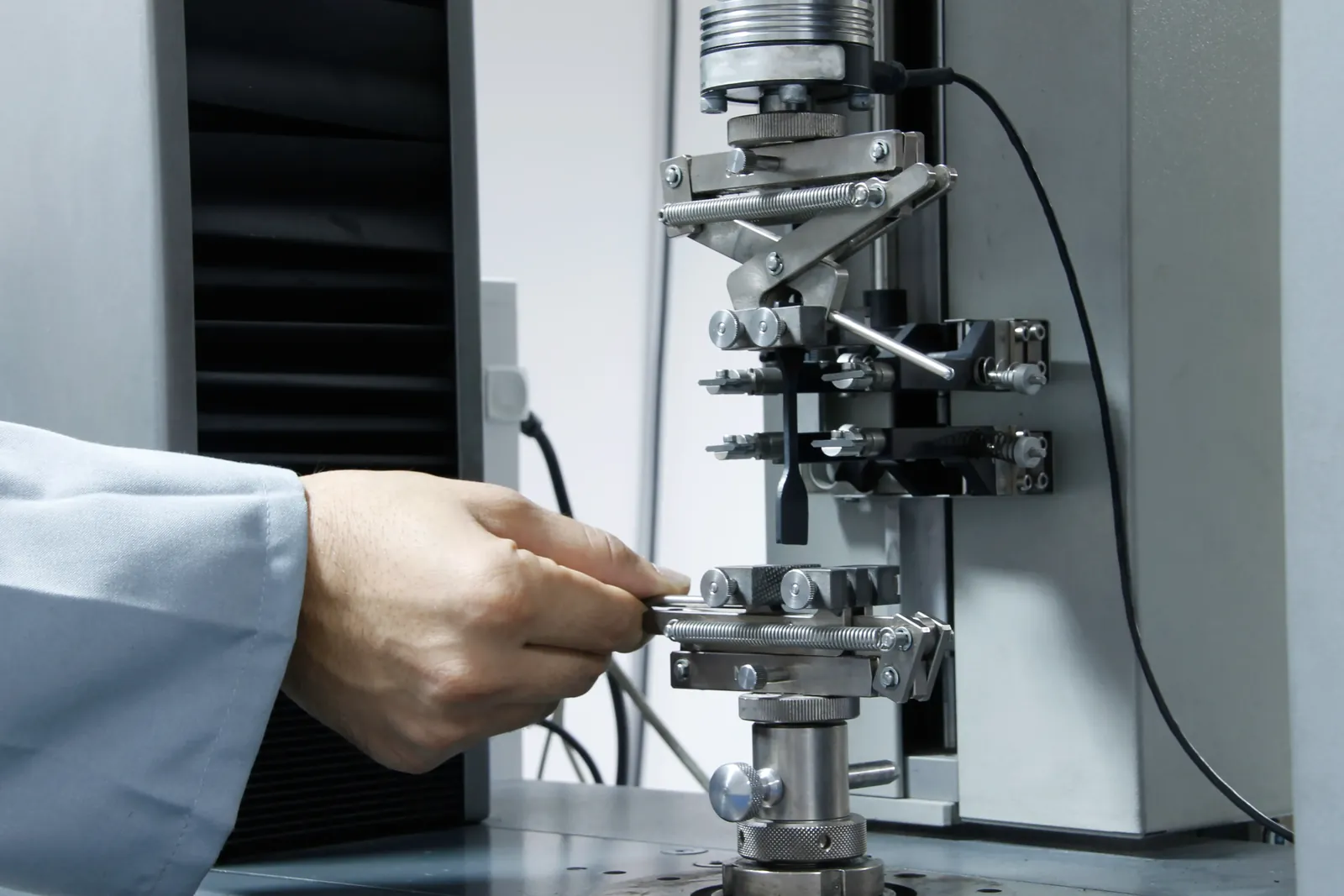
Universal testing machines
Tensile, flexural, compression and peel tests with grips and extensometers for plastics.
Pendulum impact testers
Izod and Charpy impact testing with notching equipment for consistent specimens.
HDT / Vicat testers
Heat deflection and Vicat softening temperature for heat-resistance specifications.
Density measurement
Accurate density for grade identification, filler content and quality control.
Film testing
Dart impact and related tests for packaging film strength.
Lab extruders & compounders
COLLIN systems for formulation trials, masterbatch development and specimen production.
Blown & cast film lines
COLLIN lab and pilot film lines for new structures and resin trials.
Mills & presses
Two-roll mills and platen presses for sheets and moulded test specimens.
Test methods
Plastic testing standards
Methods we most often equip plastics laboratories for.
| Test | Typical standards |
|---|---|
| Melt flow rate | ISO 1133 · ASTM D1238 |
| Tensile properties | ISO 527 · ASTM D638 |
| Flexural properties | ISO 178 · ASTM D790 |
| Izod / Charpy impact | ISO 180 / ISO 179 · ASTM D256 |
| Heat deflection temperature | ISO 75 · ASTM D648 |
| Vicat softening temperature | ISO 306 · ASTM D1525 |
| Density | ISO 1183 · ASTM D792 |
| Film dart impact | ASTM D1709 |
Buying guide
How to equip a plastics testing laboratory
Build the lab in the order that protects your production first.
Start with melt flow
Melt flow rate is the first property on most resin data sheets and the fastest way to catch an off-grade lot. A melt flow indexer is usually the first instrument a plastics QC lab buys.
Add mechanical testing
A universal testing machine with plastic grips covers tensile and flexural tests on resins, compounds and finished parts. Choose capacity and extensometer to your specimen types.
Measure toughness
Impact testers reveal brittleness from wrong formulations, poor dispersion or degraded regrind. Use a notcher so every specimen is prepared the same way.
Check heat resistance
HDT and Vicat testers matter for pipes, automotive and appliance parts where service temperatures are specified.
Make consistent specimens
Results depend on specimen preparation. Injection- or compression-moulded specimens from a press, mill or lab extruder remove variation from the test.
Consider lab-scale processing
If you develop masterbatch, compounds or film, a COLLIN lab line lets you trial formulations with small material quantities without stopping production.
Technical guide
Plastic testing equipment explained: a technical guide
Why melt flow rate matters
Melt flow rate is a simple indicator of a polymer’s molecular weight and processability. A lot with a higher melt flow than specified will flow more easily but may give lower strength; a lower value may cause processing problems such as short shots or high pressure. Checking melt flow on every incoming lot with plastic testing equipment catches these issues before they reach the machine.
Mechanical properties and specimen orientation
Injection-moulded and extruded plastics have oriented molecules, so properties differ with direction. Standards define specimen shapes and moulding conditions to make results comparable. When testing finished products, note the orientation of cut specimens, and compare like with like.
Impact resistance and temperature
Many plastics become brittle at low temperatures. Impact testing at room temperature is the routine check, while low-temperature impact testing is important for products used outdoors or in cold storage. Notch sensitivity also varies widely between polymers, which is why Izod and Charpy tests use standard notches.
Heat resistance for demanding products
Heat deflection and Vicat tests indicate how a plastic behaves near its softening range. They are routine for pipes, fittings, automotive parts and appliance components. Fillers and reinforcements raise these values, so they are also useful for checking compound formulations.
Testing recycled and filled compounds
Recycled content, fillers and additives make properties more variable. A well-equipped lab with plastic testing equipment for melt flow, density, ash content and mechanical tests lets compounders blend recycled material confidently while still meeting customer specifications.
Building a test plan
Start with the properties your customers specify, map each to a standard method and test frequency, then decide which tests happen on every lot and which are periodic. This test plan determines the plastic testing equipment you need and keeps your laboratory focused on decisions that matter.
Standards
Plastic testing equipment standards explained
ISO 1133 and ASTM D1238
Melt flow rate and melt volume rate methods. They define the barrel, die and piston dimensions, temperatures and loads for each polymer family, and procedures A (mass) and B (volume).
ISO 527 and ASTM D638
Tensile methods for plastics covering specimen types, test speeds and calculation of modulus, yield and break properties.
ISO 178 and ASTM D790
Three-point bending methods giving flexural strength and modulus, important for stiff parts and reinforced plastics.
ISO 179, ISO 180 and ASTM D256
Charpy and Izod pendulum impact methods using notched or unnotched specimens to measure impact strength.
ISO 75 and ASTM D648
Heat deflection temperature under load, indicating the temperature at which a specimen deflects a set amount under a defined stress.
ISO 306 and ASTM D1525
Vicat softening temperature, the temperature at which a flat-ended needle penetrates the specimen by 1 mm under a set load.
ISO 1183 and ASTM D792
Density methods, including immersion techniques, used for grade identification and filler checks.
Budgeting
Plastic testing equipment: what affects the price in Pakistan
Indicative factors that change a quotation. We always explain the options so you can balance budget and capability.
Instrument automation
Manual melt flow indexers are economical; automatic cutting, weighing and MVR measurement cost more but improve repeatability.
Force capacity and extensometry
A low-capacity UTM with a suitable extensometer is sufficient for most plastics; high-strain extensometers cost more.
Impact tester range
Pendulum energies and the need for both Izod and Charpy modes affect price.
Thermal testers
Multi-station HDT/Vicat instruments cost more but test several specimens at once.
Specimen preparation
Presses, moulds and notchers are essential and should be included in the budget.
Lab processing lines
COLLIN extruders and film lines are a separate investment sized to your development needs.
Applications
Who uses plastic testing equipment
Masterbatch & compounders
Formulation development, dispersion and batch-to-batch consistency.
Film & packaging
Film trials, strength and impact checks for packaging performance.
Pipe & profile extruders
Raw material acceptance and product property checks.
Injection moulders
Resin acceptance and moulded part testing.
Resin distributors
Verifying supplied grades against data sheets.
Universities & research
Polymer science and processing research.
Set-up checklist
Plastic testing equipment buying checklist
Work through these points and your quotation will be faster and more accurate.
- List resins and products you test
- Identify ISO or ASTM methods required by customers
- Start with melt flow indexing for incoming resin
- Add tensile and flexural testing on a UTM
- Add impact testing with a notcher
- Consider HDT/Vicat for heat-resistance specifications
- Plan specimen moulding with a press or lab extruder
- Arrange conditioning of specimens before testing
- Set pass/fail limits from resin data sheets
- Train operators on consistent specimen preparation
After-sales
Training and support
We install your plastic testing equipment, set up methods for your standards, and train operators on specimen preparation and test procedure, the biggest source of variation in plastics testing.
We supply dies, pistons, cleaning tools, grips and other consumables, and support calibration so your results stay consistent.
Typical set-ups
Typical plastic testing equipment configurations
Three common starting points. Every quotation is tailored to your tests and budget.
Resin acceptance lab
A melt flow indexer, density measurement and a balance. Suits moulders and converters checking incoming resin lots.
Product QC lab
Adds a universal testing machine with plastic grips, an impact tester with notcher, and HDT/Vicat. Suits pipe, film and moulded-part producers certifying products.
Development lab
Adds COLLIN lab extruders, film lines, mills and presses for formulation trials and specimen production, plus extended mechanical and thermal testing.
Avoid these
Common plastic testing equipment buying mistakes
Testing without conditioning
Many plastics, especially nylons, change properties with moisture. Condition specimens as the standard requires.
Inconsistent specimen moulding
Specimen preparation drives result variation. Standardise moulding conditions.
Wrong melt flow conditions
Temperature and load must match the resin’s specified condition; otherwise results cannot be compared.
Using a high-capacity UTM for small specimens
Low forces need a suitable load cell for accuracy.
Ignoring regrind effects
Regrind and recycled content change properties; test them separately.
No pass/fail limits
Set acceptance limits from data sheets and customer specifications so decisions are fast.
Maintenance
Maintenance and calibration schedule
A practical routine that keeps results accurate. Always follow the manufacturer instructions and your quality system.
| Interval | Recommended tasks |
|---|---|
| Daily | Clean melt flow barrel, piston and die; check temperature; verify balance. |
| Weekly | Inspect impact pendulum and notcher blades; check grips. |
| Monthly | Verify temperature and load accuracy of melt flow indexer. |
| Annually | Calibrate UTM force, impact energy and thermal instruments. |
| As needed | Replace worn dies, notcher blades and grip faces. |
Request for quotation
Plastic testing equipment quotation checklist
- Resins and products tested
- ISO or ASTM methods
- Specimen types and sizes
- Daily sample volume
- Conditioning requirements
- Need for lab-scale processing
- Film, sheet or compound trials
- Reporting needs
- Space and utilities
- Delivery city and timeline
Local support
Plastic testing equipment support across Pakistan
We help plastics and packaging producers across Pakistan set up practical QC laboratories, from Karachi and Lahore to Faisalabad.
For development work we configure COLLIN lab and pilot lines as authorised distributor, with installation, training and spare parts support.
Glossary
Plastic testing equipment glossary
MFR
Melt flow rate, the mass of polymer extruded in 10 minutes under a set load and temperature.
MVR
Melt volume rate, the volume equivalent of MFR.
HDT
Heat deflection temperature under a specified load.
Vicat softening temperature
The temperature at which a needle penetrates the specimen by 1 mm.
Izod / Charpy
Pendulum impact tests using different specimen supports.
Masterbatch
A concentrated mixture of pigments or additives in a carrier polymer.
Dispersion
How evenly pigments or additives are distributed in the polymer.
Conditioning
Holding specimens at standard temperature and humidity before testing.
Related equipment
Further reading: ASTM D1238 melt flow rate · COLLIN Lab & Pilot Solutions
FAQ
Plastic testing equipment: frequently asked questions
What is the first plastic testing instrument a lab should buy?
For most resin users, a melt flow indexer, because melt flow rate is the key incoming-material parameter on resin data sheets. Mechanical and impact testing usually follow.
Why does specimen preparation matter so much?
Moulding conditions change molecular orientation, crystallinity and voids, which change test results. Consistent specimens from a press, mill or lab extruder make results comparable over time.
Can you supply equipment for masterbatch dispersion trials?
Yes. COLLIN lab extruders, film lines and presses are widely used to check dispersion and colour by producing small film or plate samples.
Which standards do plastic testing instruments follow?
Most follow ISO (e.g. ISO 1133, ISO 527, ISO 179) or ASTM (e.g. ASTM D1238, D638, D256) methods. We configure equipment to the standards your customers specify.
Do you deliver plastic testing equipment across Pakistan?
Yes, to Karachi, Lahore, Faisalabad, Islamabad and other industrial centres, with installation and training.
How long does a melt flow test take?
Typically under 30 minutes including heating and preheating, depending on the polymer and method.
Do plastics need conditioning before testing?
Many standards require conditioning at specified temperature and humidity, especially for hygroscopic polymers such as nylon.
Can recycled plastics be tested the same way?
Yes. Testing recycled content is especially important because properties vary more between lots.
Which impact test should I use?
Follow your customer specification. Izod is common in ASTM practice and Charpy in ISO practice.
Can you help set up a masterbatch QC lab?
Yes. We combine melt flow, dispersion trials on COLLIN equipment and colour checks into a practical QC workflow.
How do I test masterbatch dispersion?
A common approach is producing thin film or pressed plates on lab equipment and inspecting for specks and streaks, or running filter pressure tests where specified.
Can one lab test both film and moulded parts?
Yes, with suitable fixtures and specimen preparation for each.
Do you supply humidity conditioning cabinets?
We can source conditioning equipment as part of a plastics laboratory.
What is the difference between MFR and MVR?
MFR (melt flow rate) is measured in grams per 10 minutes by weighing extrudate; MVR (melt volume rate) is measured in cubic centimetres per 10 minutes from piston travel. MVR needs an instrument with displacement measurement and is useful for automated testing; both are defined in ISO 1133 and ASTM D1238.
Can plastic testing equipment be used for compounds with glass fibre?
Yes, though filled and reinforced compounds may need appropriate grips, specimen preparation and sometimes higher-capacity load cells. We configure the equipment for your materials.
Request a quote
Get a quote for plastic testing equipment
An engineer replies within one working day with a recommendation and a quotation.
- Phone+92 21 3416 2044
- WhatsApp+92 331 229 5410
- Emailsales@comprehensive-sol.com
- OfficePlot No. 400, Delhi Saudagaran Society, Shah Faisal Colony, Karachi 75210