
Arun Technology · authorised distributor
Know your metal’s chemistry in under a minute
Arun Technology spark optical emission spectrometers and LIBS analysers for foundries, steel producers, metal processors and laboratories, supplied, installed and supported in Pakistan.
On this page
Overview
How an optical emission spectrometer works
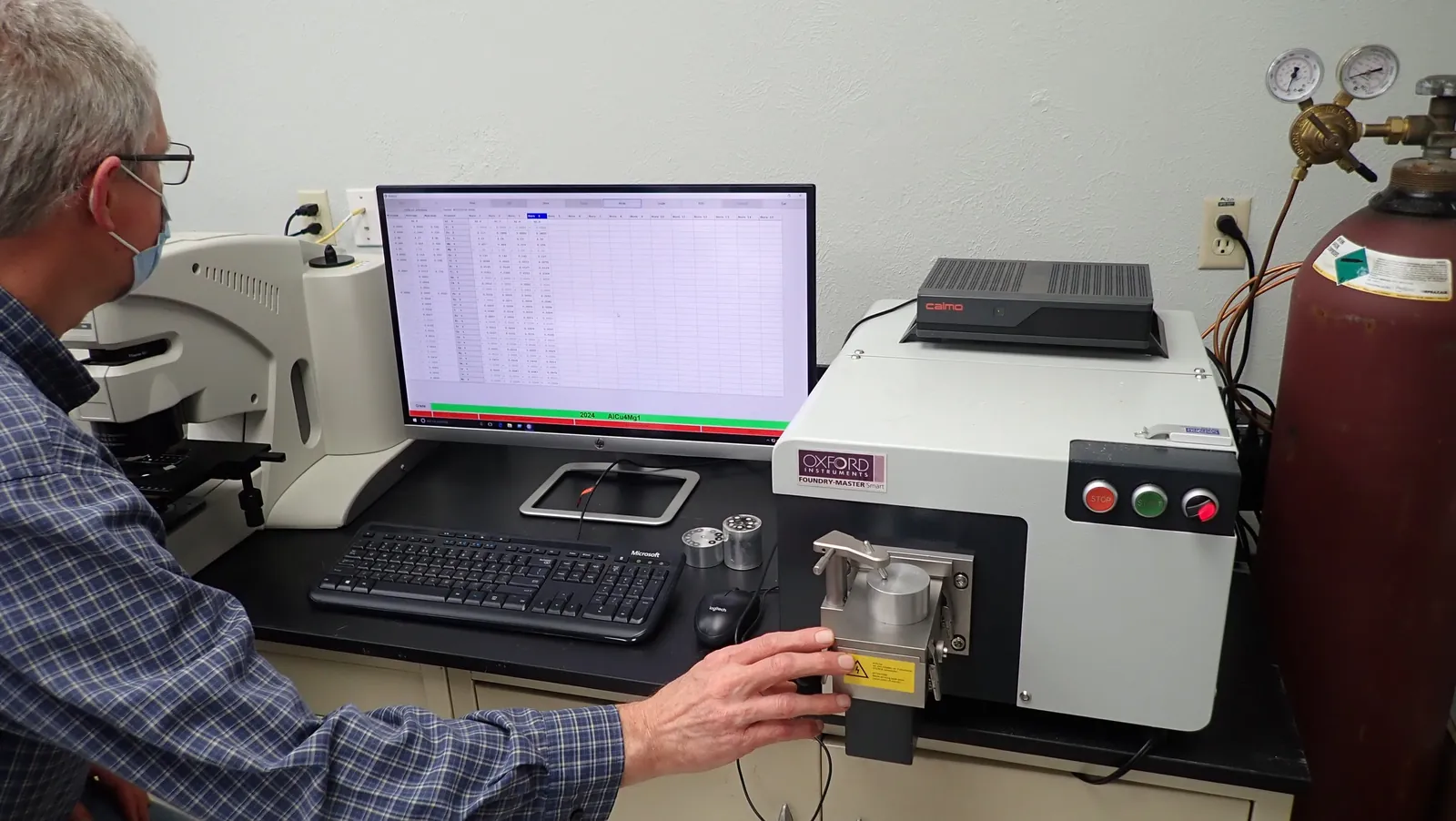
In spark optical emission spectrometry (OES), a controlled electrical spark vaporises a tiny amount of the sample surface in an argon atmosphere. The excited atoms emit light at wavelengths characteristic of each element. The optical emission spectrometer separates that light, measures its intensity and converts it into concentrations using calibration curves.
Spark OES is the established method for routine, quantitative analysis of steels, cast irons and non-ferrous alloys, including light elements such as carbon, phosphorus and sulphur. Results arrive in well under a minute, which is why foundries use it to correct the melt before pouring.
LIBS (laser-induced breakdown spectroscopy) replaces the spark with a laser pulse, enabling compact handheld analysers for checks away from the laboratory. As the authorised distributor of Arun Technology in Pakistan, we supply both.
What we supply
Arun Technology spectrometers we supply
Arun Technology has built optical emission spectrometers in the UK since launching one of the first portable CCD-based OES analysers in 1989.
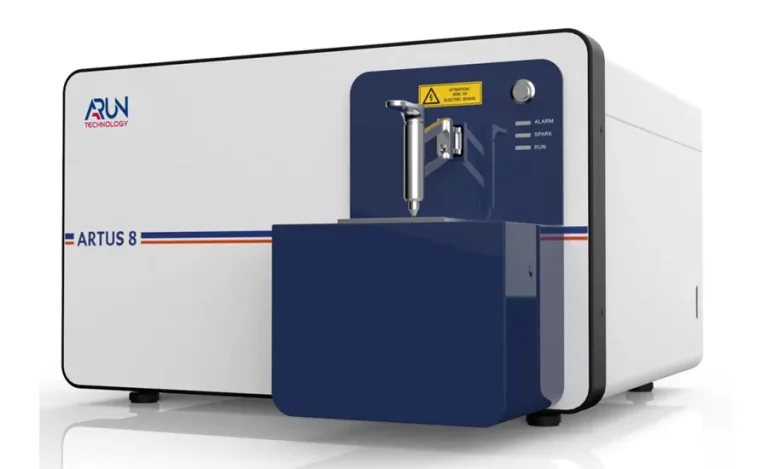
ARTUS 8 spark OES
A high-performance CMOS spectrometer with analytical programmes for cast irons and steels, including carbon and nitrogen, and the alloying and trace elements needed for melt treatment.
MERLIN 4 spark OES
A versatile mid-range CMOS spectrometer, available as a dedicated single-base unit or a flexible multi-base system for several alloy families.
CALIBUS 5 handheld LIBS
A CMOS-based laser emission analyser designed to measure carbon in ferrous materials outside the laboratory.
Calibration programmes
Matrix bases and element ranges configured for iron, aluminium, copper and other alloy families you analyse.
Sample preparation
Grinders and milling machines to produce the flat, clean surfaces spark OES requires.
Consumables & argon setup
Electrodes, spark-stand parts and guidance on high-purity argon supply for stable results.
Test methods
Optical emission spectrometer test methods
Common methods for spark atomic emission analysis by material.
| Material | Typical standard | Typical use |
|---|---|---|
| Carbon & low-alloy steel | ASTM E415 | Grade verification, melt control |
| Austenitic stainless steel | ASTM E1086 | Grade verification, PMI |
| Cast iron | ASTM E1999 | Melt treatment, carbon equivalent |
| Aluminium & alloys | ASTM E1251 | Alloy verification, foundry QC |
Buying guide
Choosing the right optical emission spectrometer
What to define before you compare spectrometers.
Which base metals do you analyse?
List every alloy family: low-alloy steel, stainless, cast iron, aluminium, copper, nickel. Each requires a matrix base and calibration programme. One-base instruments are economical for single-alloy plants; multi-base systems suit job shops and service labs.
Which elements and ranges matter?
Carbon, nitrogen, boron and trace residuals drive both the optics and the price. Confirm the elements on your customers’ specifications and the detection limits you need, especially for low-carbon and micro-alloyed grades.
Lab, plant floor or handheld?
Spark OES delivers full quantitative analysis in the lab or near the furnace. Handheld LIBS checks stock, scrap and installed components where a sample cannot be taken. Many plants use both.
How many samples per shift?
High-volume foundries benefit from fast analysis cycles, robust spark stands and simple sample preparation. Lower-volume labs may prioritise flexibility across many alloys.
Utilities and environment
Spark OES needs stable power, high-purity argon and a reasonably clean, temperature-stable room. We review your site before quoting.
Support and standardisation
Routine standardisation with reference samples keeps results accurate. Local support for training, consumables and service matters as much as the instrument itself.
Technical guide
Optical emission spectrometer explained: a technical guide
Why sample preparation decides optical emission spectrometer accuracy
An optical emission spectrometer analyses only the top few micrometres of the sample surface. If that surface is oxidised, contaminated or not flat, the spark wanders and the result is wrong. Ferrous samples are usually ground with a fresh abrasive; non-ferrous samples are often milled or lathed. Using separate abrasives for different alloy families prevents cross-contamination, and preparing the sample just before analysis keeps the surface clean.
Matrix bases and calibration programmes
Each optical emission spectrometer calibration is built for a base metal, such as iron, aluminium or copper, because the base metal affects how other elements emit light. Within each base, programmes cover groups such as low-alloy steel, stainless steel or cast iron. Choosing the right bases and programmes at purchase is important, because adding them later can require additional calibration work.
Standardisation and control samples
Every optical emission spectrometer drifts slightly with temperature, electrode wear and optical changes. Standardisation (also called recalibration or drift correction) uses a small set of homogeneous reference samples to correct this drift. Laboratories also run control samples with known composition and chart the results, so they can see when an instrument needs attention before customer results are affected.
Carbon, nitrogen and other light elements
Light elements such as carbon, phosphorus, sulphur and nitrogen emit in the vacuum-ultraviolet region, which requires optics purged with argon or held under vacuum. These elements matter enormously for steel grades, weldability and casting quality, so check that the optical emission spectrometer you choose covers them at the ranges your specifications require.
Spark OES versus XRF for metals
X-ray fluorescence analysers are common for alloy sorting, but they cannot measure carbon and are less suited to light elements. For steel and cast-iron production, where carbon controls the grade, an optical emission spectrometer is the standard choice. Handheld LIBS analysers such as CALIBUS add carbon measurement in a portable format for field checks.
Budgeting
Optical emission spectrometer: what affects the price in Pakistan
Indicative factors that change a quotation. We always explain the options so you can balance budget and capability.
Number of matrix bases
Each alloy family (iron, aluminium, copper, nickel) requires its own base and calibration. Single-base instruments cost less than multi-base systems.
Element range and detection limits
Measuring nitrogen, boron, very low carbon or trace residuals requires extended optics and drives price.
Instrument class
Laboratory-grade spark OES such as ARTUS 8 is priced above versatile mid-range instruments such as MERLIN 4, reflecting performance.
Handheld analysers
Handheld LIBS is a separate investment and complements, rather than replaces, a laboratory spectrometer.
Sample preparation
A grinder or milling machine is needed for spark OES and should be budgeted with the spectrometer.
Argon and consumables
High-purity argon, electrodes and standardisation samples are ongoing costs to plan for.
Applications
Who uses optical emission spectrometers
Foundries
Check and correct melt chemistry before pouring to avoid scrap castings.
Steel & rebar mills
Verify every heat against the specified grade before dispatch.
Metal processors
Incoming inspection of billets, bars, sheet and scrap.
Fabricators
Positive material identification before welding and machining.
Failure analysis labs
Confirm whether a failed part was made from the specified alloy.
Universities
Metallurgy teaching and alloy development research.
Set-up checklist
Optical emission spectrometer buying checklist
Work through these points and your quotation will be faster and more accurate.
- List every alloy family and grade you analyse
- Define the elements and detection limits you need
- Decide between single-base and multi-base configuration
- Plan the location: lab or near the furnace
- Arrange high-purity argon supply and regulators
- Budget for a sample grinder or milling machine
- Obtain reference and standardisation samples
- Confirm power stability and room conditions
- Plan operator training and standardisation routine
- Agree on service and consumables support
After-sales
Installation, training and standardisation
We coordinate delivery and installation of your optical emission spectrometer, set up argon supply and sample preparation, and train operators on sample grinding, spark positioning, standardisation and result interpretation.
Ongoing, we supply electrodes, spark-stand consumables and reference samples, and coordinate technical support with Arun Technology to keep your analyser accurate and available.
Typical set-ups
Typical optical emission spectrometer configurations
Three common starting points. Every quotation is tailored to your tests and budget.
Single-alloy foundry
A single-base spark OES calibrated for your alloy family, with a sample grinder and standardisation samples. Suits iron and steel foundries focused on one material.
Multi-alloy production
A multi-base spectrometer covering iron, aluminium and copper alloys, with expanded element ranges and sample preparation for each matrix. Suits job foundries and metal processors.
Lab plus field
A laboratory spark OES as the reference instrument plus handheld CALIBUS LIBS for positive material identification on stock, scrap and installed parts.
Avoid these
Common optical emission spectrometer buying mistakes
Underestimating sample preparation
Spark OES needs freshly ground or milled flat surfaces; poor preparation causes most bad results.
Choosing too few matrix bases
Adding bases later can be costly. Plan for alloys you expect to analyse in future.
Poor argon quality
Impure argon or leaky lines cause unstable burns and wrong results. Use high-purity argon and good regulators.
Skipping standardisation
Spectrometers drift; routine standardisation with reference samples keeps results accurate.
Expecting handheld to replace the lab
Handheld LIBS is fast but does not replace laboratory spark OES for full quantitative analysis.
Placing the instrument in a harsh area
Dust, heat and vibration near furnaces degrade performance. Use a clean, stable room.
Maintenance
Maintenance and calibration schedule
A practical routine that keeps results accurate. Always follow the manufacturer instructions and your quality system.
| Interval | Recommended tasks |
|---|---|
| Daily | Standardise with reference samples; check argon pressure; clean the spark stand. |
| Weekly | Clean electrodes and spark stand thoroughly; inspect argon lines. |
| Monthly | Review control charts of reference samples for drift. |
| Annually | Manufacturer service of optics, vacuum or purge systems as recommended. |
| As needed | Replace electrodes and spark-stand parts; recalibrate after major service. |
Request for quotation
Optical emission spectrometer quotation checklist
- Alloy families and grades
- Elements and concentration ranges
- Required detection limits
- Samples per shift
- Sample shapes and sizes
- Lab or near-furnace location
- Argon availability
- Power and room conditions
- Need for handheld analysis
- Delivery city and timeline
Local support
Optical emission spectrometer support across Pakistan
As Arun Technology’s authorised distributor in Pakistan, we configure spectrometers for your alloys, install them, set up argon and sample preparation, and train operators on standardisation.
We supply electrodes, reference samples and consumables, and coordinate technical support with Arun Technology to keep your instrument accurate and available.
Glossary
Optical emission spectrometer glossary
Spark stand
The chamber where the electrical spark excites the sample surface.
Matrix base
The base metal (e.g. iron or aluminium) for which a calibration is built.
Standardisation
Routine correction of instrument drift using reference samples.
CMOS detector
A solid-state detector that measures light intensity at each wavelength.
LIBS
Laser-induced breakdown spectroscopy, using a laser pulse to excite the sample.
PMI
Positive material identification, confirming an alloy grade on parts or stock.
Detection limit
The lowest concentration an instrument can reliably measure.
Burn
One spark measurement on the sample surface; several burns are averaged.
Related equipment
Further reading: Arun Technology · ASTM E415
FAQ
Optical emission spectrometer: frequently asked questions
What is the difference between spark OES and LIBS?
Spark OES excites the sample with an electrical spark in argon and is the reference choice for laboratory analysis, including low carbon levels. LIBS uses a laser pulse, which allows handheld instruments for quick checks outside the lab. Arun’s CALIBUS is designed specifically to measure carbon in ferrous materials.
Can one optical emission spectrometer analyse steel, aluminium and copper?
Yes, if it is configured with multiple matrix bases and calibration programmes. The MERLIN 4 is available as a single-base or multi-base system. We specify the bases and elements you need.
How long does a spark OES analysis take?
Typically under a minute per burn, with several burns averaged per sample. Sample preparation adds a few minutes, which is why foundries keep a grinder or mill next to the spectrometer.
What utilities does a spark spectrometer need?
Stable power, high-purity argon and a clean, reasonably temperature-stable room, plus a grinder or milling machine for sample preparation.
Do you provide training and support in Pakistan?
Yes. As Arun Technology’s authorised distributor, we coordinate installation, operator training, consumables and technical support for customers across Pakistan.
Can an optical emission spectrometer measure carbon in stainless steel?
Yes. Spark OES measures carbon in stainless and low-alloy steels, including low-carbon grades, when configured with suitable optics and calibrations.
How often must the spectrometer be standardised?
Typically at least once per shift or day, depending on usage and the stability of conditions, using reference samples.
Can a spectrometer analyse small or thin samples?
Small and thin samples may need adapters or alternative techniques. Tell us your sample shapes and we will advise.
What room conditions are required?
A clean, reasonably temperature-stable room with stable power gives the best results. Avoid placing the instrument where dust or vibration is high.
Is LIBS accurate enough to replace spark OES?
LIBS is excellent for fast identification and specific tasks such as carbon in ferrous with CALIBUS, but laboratory spark OES remains the reference for full quantitative analysis.
Can a spectrometer detect nitrogen in steel?
Some configurations, such as ARTUS 8 programmes for steels, include nitrogen. Confirm your elements and we will specify accordingly.
How long does installation take?
Typically a few days including set-up, standardisation and training, depending on site readiness.
Do you provide reference samples?
Yes, we can supply certified reference materials and standardisation samples for your alloys.
Request a quote
Get a quote for an optical emission spectrometer
An engineer replies within one working day with a recommendation and a quotation.
- Phone+92 21 3416 2044
- WhatsApp+92 331 229 5410
- Emailsales@comprehensive-sol.com
- OfficePlot No. 400, Delhi Saudagaran Society, Shah Faisal Colony, Karachi 75210